An Exploration of the Harms Done by UUSA Religious Ancestors

Members of the UUSA participated in the UUA Common Read of On Repentance of Repair: Making Amends in an Unapologetic World. One of the conclusions for many of us is that we need to learn more.

The following is a list of resources used in preparation of the short essay exploring the role of our religious ancestors in harms done to Native peoples in New England. You are invited/encouraged to send me additional resources that you think should be on this list. Please send your suggestions to johngerber123@gmail.com.

Continue reading An Exploration of the Harms Done by UUSA Religious Ancestors

Let’s talk about repentance and repair

The following is an open letter to the Unitarian Universalist community of Amherst, MA. If this topic and challenge is of interest, you are invited to join us to discuss the book mentioned below. You can learn more and register on the UUSA web page.

The UUA Common Read this year is “On Repentance and Repair: Making Amends in an Unapologetic Worldby Rabbi Danya Ruttenberg.  Discussing this thoughtful book is an excellent way for the Unitarian Universalist Society of Amherst to follow what we learned in last year’s Common Read of The Indigenous People’s History of the United States about the harms done to Native Americans by our settler colonialist ancestors.  Often referred to as “America’s original sin” the mistreatment of Indigenous Peoples deserves our special attention as a Unitarian Universalist congregation with a meetinghouse residing on land taken from Native Americans, in a town named after the “poster child of white supremacy” in the 18th century, the Lord Baron General Amherst.

Continue reading Let’s talk about repentance and repair

Where will the agricultural college graduates work?

One of my most popular blog pojobssts has been “Sustainable agriculture jobs after college?”  In this next essay, I share a few thoughts about the jobs situation in sustainable agriculture – based on my experience working with young women and men graduating college.  My conclusion is that well-paying, meaningful “lifetime career” jobs that offer a sense of security are hard to find right out of college.  It may be that getting hired for a lifetime job is an unrealistic expectation for recent college grads in our emerging “on-demand” economy.  But that realization might be an opportunity!

Now, might be the time for young people to pursue their vision for a more just and equitable food system, driven by passion and grounded in pragmatism.  This might be the time for more food and farming entrepreneurs to lead us to a sustainable food system.

A national news story about Sustainable Food Jobs for example, provides an outline of the many emerging opportunities in this area.  Among the areas highlighted were:

  • Local and regional farming and marketing
  • Restaurants and food services
  • Media and marketing
  • Law and public policy
  • Public health and nutrition
  • Technology and entrepreneurship
  • Advocacy and community development
  • Teaching – especially community-based education

Many of the students who have graduated from the UMass Bachelor of Sciences program in Sustainable Food and Farming and are doing well  have created their own new work, rather than “landed a job” in the traditional sense.  I encourage graduating seniors to search the job boards online, but mostly as a way of creating a vision or coming up with a new idea for a business or service that nobody has ever thought of before!  A brainstorming session in one of my classes  came up with a serious, lighthearted, earnest, and ingenious list of future jobs that included; permaculture consultants, food delivery rickshaw drivers, herbal landscapers, wood mill operators, biodiesel processors, vermiculturists (they grow worms and make compost), urban rooftop gardeners, micro-lenders, witch doctors, AAA bicycle workers, compost toilet janitors, alternate transport specialists, population controllers, seed bank managers, urban wildcrafters….and on and on.

I try to be honest with students when they first arrive at UMass to study Sustainable Continue reading Where will the agricultural college graduates work?

What do we do?

White people are told to make sure BIPOC voices are dominant in conversations and work to dismantle white supremacy culture.

I get that.

I also hear the voice of Reesma Menakem, the author of My Grandmother’s Hands. Here are a few remarks from him while being interviewed along with Robin DiAngelo, by Krista Tippets on a podcast titled Toward a Framework for Repair, aired July 9, 2020.

“…when white folks and allies say that they’re allies, and what can we do, and you think you’re being helpful; or what should I do now?, and you think you’re being helpful, there is such a brutality to your words that, many times, I can’t fool with white folks. I can’t be around you. I need you to leave me alone. I need you to not ask me what my opinion is of a Black man getting murdered with no regard.”

“…and they’re going to have to start really beginning to figure out how they build culture around abolishing white supremacy.

Anything other than that, for me, really is — and you’ve heard me say this before — really is performance art. It is not real. If you’re not going to be with other white bodies for three to 10 years, grinding on specifically about race and specifically about the things that show up when white bodies get together to build culture, then I can’t fool with you.

The idea that people can come up to me and ask me, what should I do?, when we have Google, is just crazy on its face.

white folks have got to do this work themselves.”

NOTE: this is a powerful interview and it is worthwhile hearing these words in Reesma Menakem’s own voice. You can listen to the full interview here: On Being Podcast; July 9, 2020.

Or if you want to hear a few minutes of highlights from this interview, try this….

For more resources related to the UU Eighth Principle, see:

Are we ready to build the Beloved Community?

The Unitarian Universalist congregation that I joined recently voted to accept the UU Eighth Principle …

I thought I should try to understand what the Beloved Community might look like. Here is one description extracted from a blog titled “Pluralism, Pragmatism, Progressivism. Carl Gregg wrote…..

“In progressive religious circles, you will often hear calls to “build the Beloved Community,” but I’m not sure we always appreciate the full historic resonance of that phrase. The term “Beloved Community” was coined by the early twentieth-century American philosopher Josiah Royce (1855-1916). But most of us learned it not from Royce but from The Rev. Dr. Martin Luther King, Jr., who often spoke of the “Beloved Community” as his ultimate goal.”

As an early example, after the Montgomery Bus Boycotts in speaking about the larger movement toward which they were building, Dr. King said:

Continue reading Are we ready to build the Beloved Community?

Gleanings from “Widening the Circle”

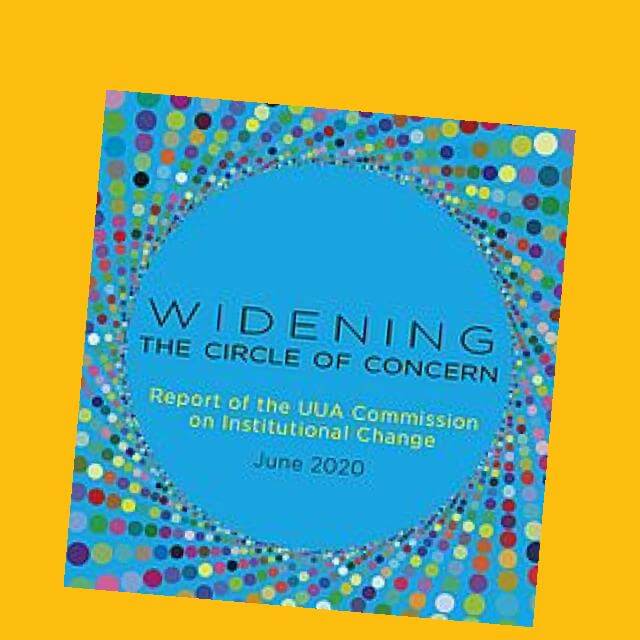
The following is personal exploration into the first few chapters of the text, Widening the Circle of Concern: Report of the UUA Commission on Institutional Change – June 2020.

This text is available free as a pdf. The following notes represent my own gleanings of statements that seemed important to me. Direct quotes from the text are indicated with quote markings. Other statements are adapted or paraphrased to make sense out of context.

NOTE to the UUSA Board of Trustees…. I wonder if it might be useful to share these quotes in the weekly UUSA Newsletter, as proposed at the most recent Board meeting?

Gleanings from the Preface

“Addressing the perennial problem of race in Unitarian Universalism is not broadly seen as a theological mandate.”

We need new definitions of multicultural competency for religious leaders (including lay leadership).

“Too few white people are engaged in intentional anti-oppression work.”

We need to articulate what a liberation theology could look like for UU’s.

Continue reading Gleanings from “Widening the Circle”

Why do we continue to honor Jeffrey Amherst?

Who exactly was Jeffery Amherst? (Joshua Reynolds)

Lord Jeffrey Amherst might be considered the 18th century poster child for white supremacy culture, yet he is still honored today….

The first half of this blog was adapted from Jordan Gill · CBC News · Posted: Apr 29, 2017

As an initiative to change the name of Port-la-Joye–Fort Amherst National Historic Site on Prince Edwards Island in Canada. is being debated, a researcher weighs in on the history of Jeffery Amherst.

Mi’kmaq elders and the Mi’kmaq Confederacy of Prince Edwards Island, Canada, have raised questions about the honouring of Amherst, by naming sites after him — arguing he was not only an enemy of Indigenous people, but worse.

To say Amherst was a decorated military man would be an understatement. He was a Field Marshal in the British Army. He served during the Seven Years’ War in New France or modern day Nova Scotia. He also held the offices of Governor of Quebec as well as Crown Governor of Virginia and was named a Lord.

But scholars have long debated Amherst’s actions during his service, including allegations he advocated the use of biological warfare, through smallpox blankets, to kill Indigenous peoples.

See an example of a scholarly document here.

Continue reading Why do we continue to honor Jeffrey Amherst?

Sustainable agriculture jobs after college?

I’m one of the academic advisers for students in our Sustainable Food and Farming program at the University of Massachusetts and I often get asked (mostly by parents) so will my kid get a job when they graduate?  Good question!

And my learned response is “…well, maybe – and maybe not”.  Then the pause – and I continue “but if they graduate from UMass they will be prepared to create good work that is needed on the planet.”  This may not be the most satisfying answer for a parent – but in a rapidly changing world where nothing seems predictable….  its honest.

But lets dig a little deeper into this question….

Getting a Job

There’s a difference between “getting a job” after graduation and creating good work (which is what I promise).  There are jobs in sustainable food and farming.  Interestingly, one of the options for college grads that was suggested in the blog post “Can’t find a job? Six alternatives” published a few years ago is working on a farm.  Some of our students in fact, do want to farm, but many are also interested in marketing food, education, public policy, advocacy and community development related to food and farming.

But a “job” may not be the best choice for everyone!  In fact, many of the jobs we will be doing in ten years may not even exist today.  The world is changing fast.What job will I get after college?” is a self-limiting question.  A more important question (that I addressed in an article about “Jobs of the Future“) is “….how are we going to live?” And especially, how are we going to live in a world in which the industrial food system is collapsing? Students in our program learn to see crisis as an opportunity for creating their own good work.

Creating Good Work

The great British economist, E.F. Schumacher, author of the classic text Small is Beautiful, wrote a lovely little book called Good Work about this topic.  According to Schumacher, good work needs to provide for three things.  It should:

1…provide a decent living (food, clothing, housing etc.).
2…enable the worker to use and perfect their native gifts.
3…allow the worker the opportunity to serve, collaborate and work with other people to free us from our inborn egocentricity.

Finding a job may serve the first need without addressing the other two.  When I ask my students if their parents are happy in their work, there is often a hesitation.  I often hear that “Dad seems okay and makes a good living – but you know he always wanted to …. (fill in the blank).

I’m sure many adults in the workforce are fulfilled by their work and challenged in a way that “frees them from their inborn egocentricity.”   But frankly, many are not.   We need good work to provide us with a reason for being and a sense of belonging if we want to be happy.

Robert Frost wrote in “Two Tramps at Mudtime”

My object in living is to unite

My avocation and my vocation…

Our dream should be to unite our avocation (that which we love) and our vocation (that which we do).  We should “love what we do and do what we love.”

While some students are trained for entry level jobs, students who want to learn to thrive in this new world learn how to learn.  They meet entrepreneurs who have followed their own dream and are busy creating new businesses, non-profit organizations, or are self-employed.  They are introduced to systems thinking, grant writing, and holistic decision-making.  They are awarded academic credit for apprenticeships or for gaining experience by “wwoofing” in  the U.S. and around the world.

This is not to deny the value of a job that “provides a decent living.”  But money is not enough.  Even during the Great Depression when the unemployment rate exceeded 25%, Franklyn Delano Roosevelt, stated in his 1933 presidential inaugural address:

Happiness lies not in the mere possession of money; it lies in the joy of achievement, in the thrill of creative effort.  The joy, the moral stimulation of work no longer must be forgotten in the mad chase of …. profits.  These dark days, my friends, will be worth all they cost us if they teach us that our true destiny is not to be ministered unto but to minister to ourselves, to our fellow men.”

To Minister to Ourselves and Others

I encourage students not to sell themselves short but to articulate and pursue their dream.  I encourage them to think about how they might be useful – to themselves and their families – but also to others and the planet.  I often share a hard hitting essay by Derrick Jensen titled Who Are You?, in which he quotes Carolyn Raffensperger, who advises us to ask what is the biggest and most important challenge we can address with our gifts and skills.  Like E.F. Schumacher, Carolyn recognizes that to be fulfilled and happy we must not only provide for our own living – we  must “minister to ourselves and others.

Good work will provide us with a living, allow us to perfect our gifts, and perhaps most importantly…

…good work will allow us to be useful to others and the planet.

There is much work to be done on a planet facing the “perfect storm” of climate change, peak oil and global pandemic.  Business as usual is not enough.  We know that crisis creates opportunity for those willing to try something new.

At a time when the federal government seems intent on stimulating the economy by encouraging new industrial jobs – we need to learn how to create good work by focusing on what is really needed.

======================================================

Our Sharing garden

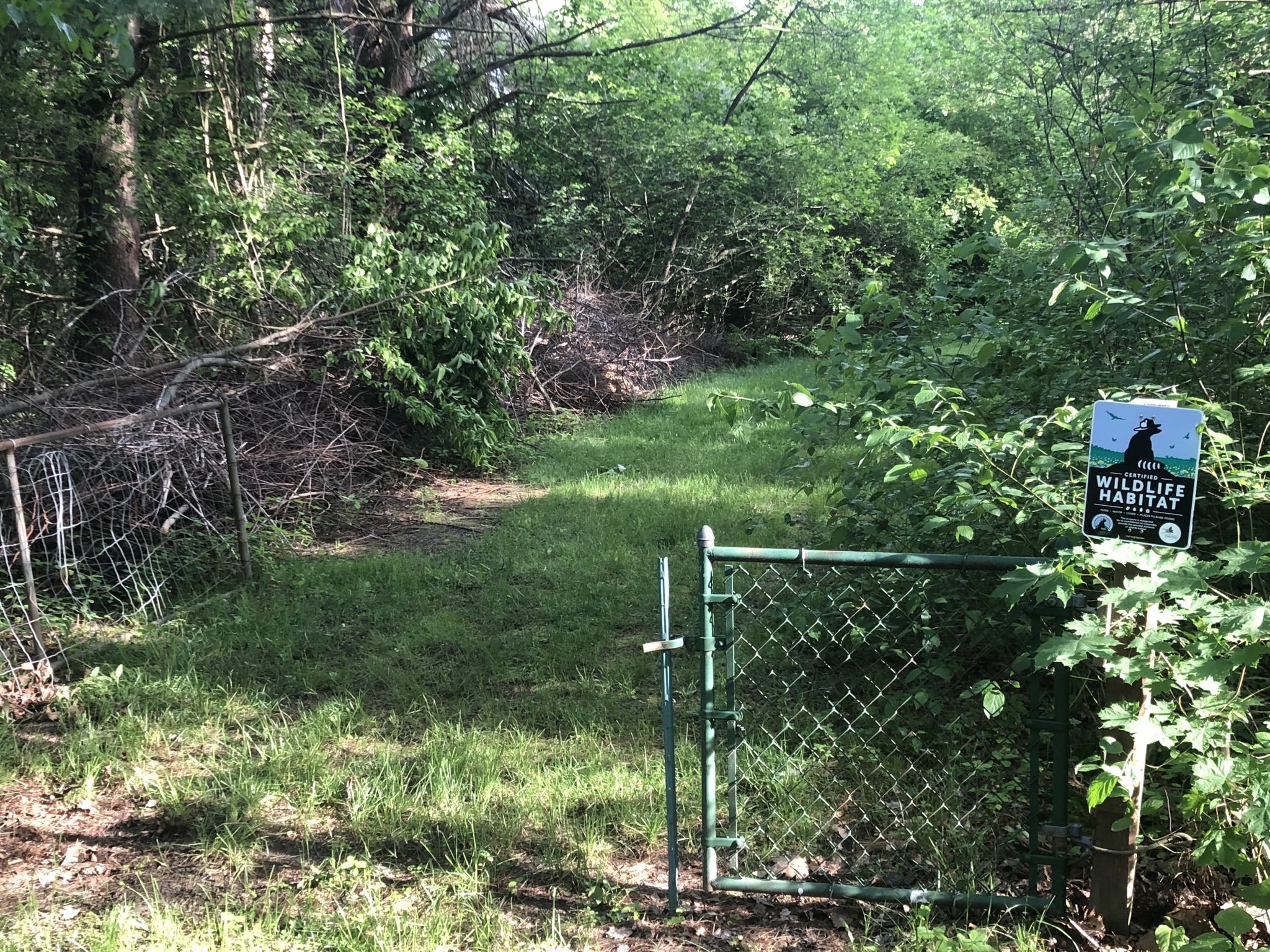
There is a garden where you are welcome to come and sit, walk, meditate, pick blueberries when they are ready, cut flowers in season, and bring your kids to see the chickens…..

The entrance to the garden is through a gate between 132 and 158 Rolling Ridge Rd., right next to the walking path between Harlow and Rolling Ridge. This almost one acre garden produced vegetables, chickens and turkeys for my family for many years. Now that I am living alone, I would like to share the garden with neighbors.

Anytime the gate is open, you are welcome to come in and explore.

This garden is currently under development as I have done very little there for the past few years. I asked an ecological landscape designer to give me some advice and they produced a map as a guide to development, which will likely take several years.

I am not following the design exactly, but this gives you an idea of what it might be like someday.

This project is related to a study I did on our neighborhood last winter that may be seen here: https://changingthestory.net/2020/11/22/our-backyard/

If you would like to be on an email list to receive notice when something is ready to pick, please send me a note at jgerber@umass.edu.

Welcome to the sharing garden……

Systems Thinking for a More Sustaianble World

New Thought Evolutionary

Creating The Beloved Community - Together

Amadou It All

A Fascinating Fungal Fabric and a Humungous Human History

Levi Stockbridge Lessons and Legacy

What can we learn today from "Prof Stock"?

The Niche

Trusted stem cell blog & resources