
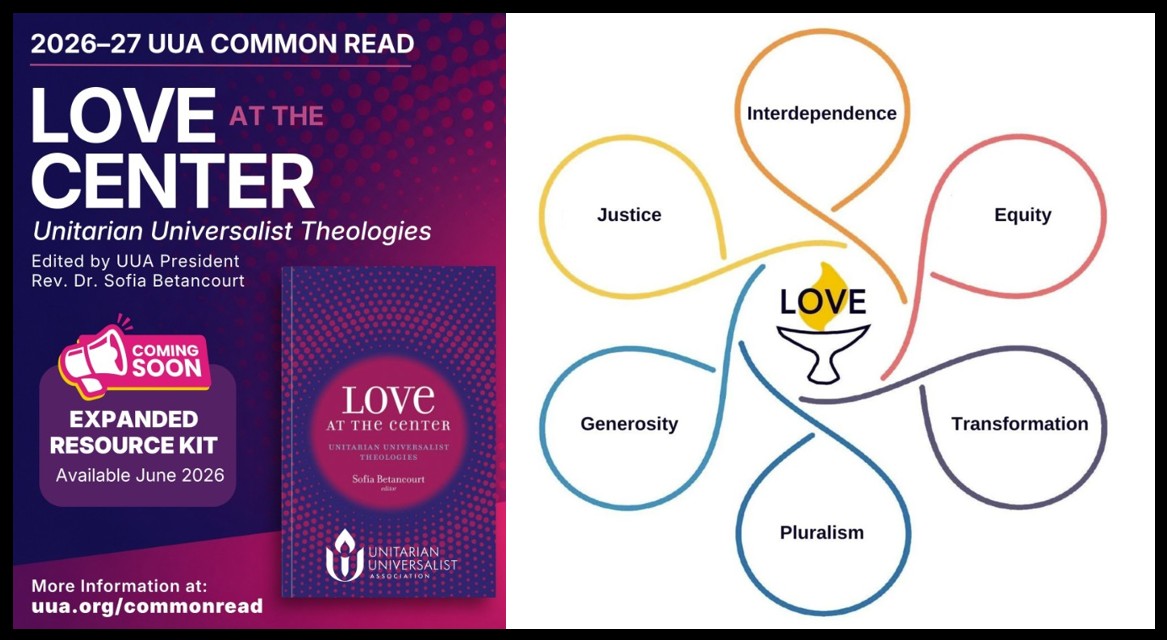
Learn more about the new UUA Common Read
My faith community, the Unitarian Universalist Society of Amherst, voted to adopt the UU Eighth Principle which commits us to building the Beloved Community. The national Unitarian Universalist Association has approved a new set of shared values with love at the center … so…. now what? Well, I thought that I should try to understand what the Beloved Community might look like.
Here is a bit of history extracted from a blog titled “Pluralism, Pragmatism, Progressivism. Carl Gregg wrote…..
“The term “Beloved Community” was coined by the early twentieth-century American philosopher Josiah Royce (1855-1916). But most of us learned it not from Royce but from The Rev. Dr. Martin Luther King, Jr., who often spoke of the “Beloved Community” as his ultimate goal.”
As an early example, after the Montgomery Bus Boycotts in speaking about the larger movement toward which they were building, Dr. King said:

For King, building the Beloved Community requires the hard work of reconciliation and redemption, and of transforming opponents into friends.
According to The King Center:
“For Dr. King, The Beloved Community was not a lofty utopian goal to be confused with the rapturous image of the Peaceable Kingdom, in which lions and lambs coexist in idyllic harmony. Rather, The Beloved Community was for him a realistic, achievable goal that could be attained by a critical mass of people committed to and trained in the philosophy and methods of nonviolence.“
We might also ask “so what are the characteristics of the Beloved Community?” The essay from Religion & Race outlines 25 characteristics of the Beloved Community.
Dr. King’s friend, the Buddhist monk, Thich Nhat Hanh extended the Beloved Community to all sentient beings, but he called it his sangha. In 2014, forty-six years after King’s assassination, he wrote: “I was in New York when I heard the news of his assassination; I was devastated. I could not eat; I could not sleep. I made a deep vow to continue building what he called ‘the beloved community,’ not only for myself but for him also.”
As Thich Nhat Hanh says, “The next Buddha may take the form of a community practicing understanding and loving kindness, a community practicing mindful living.
For those of us who want to explore what the Beloved Community might look like in action, the UUA has provided a set of new resources. The 2026-27 Common Read is Love at the Center. The UUA has offered UU congregations guidance on how to engage with this new book. Please check out the video by UUA President Sofia Betancourt!


One thought on “Are we ready to build the Beloved Community and put Love at the Center?”