
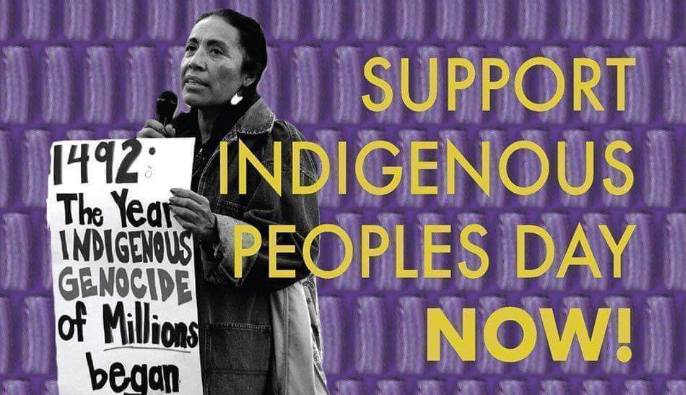
Our local State Senator, Jo Comerford, is the sponsor of a bill to change October 12 from Columbus Day to Indigenous Peoples Day. Senator Comerford said about Columbus… “His arrival marked the beginning of colonization, dispossession, enslavement and violence against Indigenous people. And… “that is not an inconvenient footnote. It is part of our history, and we have a responsibility to tell it honestly — especially as we mark 250 years of America.”
The legislation Comerford filed in the current 2025-2026 legislative session is S.2113, “An Act Establishing an Indigenous Peoples Day.” Rep. Christine Barber, D-Somerville, sponsored the same proposal, H.3292, in the House.
Although Governor Healey declared October 12, 2026 as Indigenous Peoples Day, the United American Indians of New England declared…
WE’RE NOT CELEBRATING THIS PROCLAMATION. HERE’S WHY: MA Gov. Healey issued a proclamation earlier today declaring Indigenous Peoples Day in the state. But it’s just a one-time proclamation that doesn’t even get rid of Columbus Day. Indigenous Peoples Day is meant to REPLACE Columbus Day. It’s not meant to be a companion holiday to a celebration of the mass murderer and slaver who was responsible for the genocide of Taino and other Indigenous people everywhere he went.
==========================================
The following text on Christopher Columbus was taken from a post offered by Rhonda Anderson, a member of the Massachusetts Commission on Indian Affairs and was fact checked online.
Here’s something they probably didn’t teach you in elementary school: Christopher Columbus was so brutal that the Spanish government arrested him, put him in chains, and shipped him home.
And then, centuries later, Americans gave him a holiday.
I’m not kidding. The people who actually lived during Columbus’s lifetime knew things about him that somehow never made it into our little school lessons about sailing the ocean blue.
Let’s talk about what this man actually did.
When Columbus reached the Caribbean in 1492, he found thriving Indigenous civilizations. These people welcomed him, traded with him, and helped his crew. His response? He wrote about how easily they could be conquered and enslaved.
He immediately began kidnapping people.
By 1495, his men had rounded up hundreds of Indigenous people to send across the Atlantic as slaves. Approximately 500 were loaded onto ships. Around 200 reportedly died during the crossing.
He imposed a system requiring Indigenous people to regularly deliver gold to their Spanish rulers, even though the amounts demanded were often impossible to obtain. People were driven into desperate labor. Those who resisted faced military attacks, and Spaniards used vicious dogs against fleeing Indigenous people.
His colonial regime brought warfare, starvation, forced labor, sexual violence, and devastating suffering to the Taíno people.
And the sexual violence is particularly horrifying.
One of Columbus’s own companions, Michele de Cuneo, wrote about Columbus giving him a captured Indigenous woman. Cuneo described how she resisted his sexual advances, how he beat her, and how he forced himself on her.
We don’t have to speculate about this. The man wrote about it himself.
Columbus was also cruel to Europeans living under his authority.
A Spanish investigation in 1500 collected testimony describing horrific punishments under Columbus and his brothers. People were flogged, mutilated, and executed. One woman reportedly had her tongue cut out after insulting the Columbus family. According to the investigation, Christopher approved of his brother’s punishment.
And here’s the part I really want you to understand.
Even people living in the 1400s thought his conduct was outrageous.
Not everyone, of course. He had supporters. But complaints about his rule became so serious that the Spanish monarchs sent Francisco de Bobadilla to investigate. Columbus and his brothers were arrested, and Columbus was returned to Spain in chains.
He was eventually released and allowed to make another voyage, but he never regained his governorship.
Think about that. The Spanish monarchy was actively sponsoring conquest and colonization, and its own officials still found reason to remove Columbus from power.
So how in the world did this man become an American hero?
Well, there’s a fascinating answer.
Columbus wasn’t always the towering American icon we know today. During the American Revolution and afterward, Americans wanted a national origin story that didn’t revolve around Britain. Columbus, who had sailed for Spain, was a convenient choice.
Then Washington Irving published a wildly romanticized biography in 1828, helping turn Columbus into a courageous genius fighting ignorance. That’s part of how the ridiculous story about Columbus proving the Earth was round became popular. Educated Europeans already knew the Earth was spherical.
Later, Italian Americans, who faced terrible discrimination and violence themselves, embraced the Genoa-born explorer as a symbol of pride and belonging. That part of the story deserves some compassion. They were trying to establish a place for themselves in a country that frequently treated them as outsiders.
Columbus celebrations grew, presidents promoted them, and eventually Congress made Columbus Day a federal holiday, first observed as such in 1971.
And generations of American children learned about three little ships and a brave explorer who discovered America.
Except he didn’t discover America. Millions of Indigenous people already lived here, and Norse explorers had reached North America centuries earlier.
He didn’t prove the Earth was round.
He didn’t even know he had reached continents previously unknown to Europeans.
But he did help establish a colonial system that inflicted catastrophic suffering on the people who were already here.
And somehow, THAT part of the story got pushed aside.
I think it’s fascinating how thoroughly a society can manufacture a hero by choosing which parts of his story to tell.
Because the documented history of Christopher Columbus is disturbing enough without exaggerating a single thing.
The question isn’t why people have started questioning Columbus. It’s why we spent so many generations teaching children to admire him without telling them what he actually did.
===================================
Senator Comerford said Columbus Day is not needed as a way to recognize Italian-Americans. “We can honor Italian-American heritage. And we can honor Indigenous people,” she said. “In 2021, President Biden became the first U.S. president to formally recognize Indigenous Peoples Day. It is time for Massachusetts to do the same.”

