A Renaisance Garden Grows in Massachusetts

AMHERST, Mass. – Visitors to the Massachusetts Center for Interdisciplinary Renaissance Studies in Amherst, MA this summer can enjoy the sense of traveling back in time to experience sights, smells and tastes of an authentic 16th-century kitchen garden, now open for tours.  UMass Stockbridge School of Agriculture Sustainable Food and Farming students raised historic fruit and vegetable varieties to create the full-scale replica on the center’s grounds.

Many plants chosen for the 1500’s-era garden are based on research by recent Mt. Holyoke environmental studies and nature culture history graduate Jennie Bergeron, who steeped herself in Renaissance herbal lore at the center’s library to help plan the project, which was first envisioned by Center Director, UMass Professor Arthur Kinney.
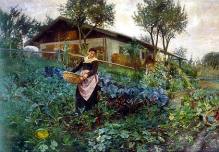
“This garden is what we are calling a ‘pottage’ or kitchen garden,” says Bergeron. “It represents the utilitarian garden of the common family of 400 years ago and contains both herbs and vegetables, with a couple kinds of flowers, but mainly herbs that were used in the daily pottage food stuff of commoners.”

“Pottage” was thin, onion- or garlic-based broth made with whatever was available from the garden or farmyard to provide the staple meal of working families. People in England, Germany, the Netherlands, Scandinavia and other northern European lands grew such crops as garlic, onions, turnips, beets, cabbage, fava beans, leeks and carrots in “pottage gardens” in medieval and Renaissance times.

Bergeron, who also serves as the head gardener for the project, says most homes also had an herb garden. In addition, wealthier people could afford more than one garden for different purposes, such as a flower garden or “herber” for sweet-smelling blooms and plants. Herbs were categorized by their use: pot, cup, floor or distillery. Hops were grown for beer; fragrant plants such as angelica, anise, tansy, yarrow, evening primrose, coriander, mugwort, hyssop, horehound and vervain for flavoring food or for “strewing” on the dirt floor because they smell good or have anti-microbial properties.  The Center’s new garden has 49 different fruits and vegetables.
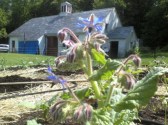
A special feature of the project was arranged by UMass Extension berry specialist Sonia Schloemann, who obtained small amounts of authentic heirloom beer hops and strawberry cuttings from the 16th and 17th century to come to the Renaissance Center garden from the USDA Germplasm Collection in Corvallis, Ore.

It will take a couple of years, but these small cuttings will be propagated by Stockbridge students in UMass greenhouses for use in the Renaissance Center gardens.  Strawberries in medieval times were much smaller and sweeter than the cultivars we are used to eating. But many other plants, for example herbs such as hyssop and anise have not changed much at all in 1,000 years. Many herb varieties we have today would be familiar to medieval gardeners.

Renaissance Center Librarian Jeff Goodhind has set up a display of books that Bergeron and her classmates used for her research, including a gardener’s almanac published in London in 1632 that lists garden chores by the month, a Latin “Dictionarium rusticum” or Rustic Dictionary from 1717 and a 1564 “Creuterbuch,” in German with hand-painted color plates, plus John Gerard’s famous folio of 1632.

The new garden, the adjacent Renaissance Apple Orchard and grounds are free and open to the public for tours and picnics from 10 a.m. to 4 p.m. Monday through Friday.  Renaissance Center staff are planning an…

Open House on Saturday, August 17 from 10:00am – 3:00pm,

…as well, for those who can’t visit during the week. A plant list and map of the pottage garden will be available for visitors.

Be sure and watch this 3 minute video describing the project.

For more background on this project, see:

Special thanks to Janet Lathrop and Elizabeth Wilda from the UMass News Office for the press release from which this post was developed and the excellent video.
===============================================================================

For more ideas, videos and challenges, please join my Facebook Group; Just Food Now.   And also check out more World.edu posts.  If you like this project, you may be interested in the 15-credit Certificate, the 2-year Associate of Sciences degrees or the 4-year B.S. Sustainable Food and Farming major in the University of Massachusetts Stockbridge School of Agriculture.

Quercus Questions: "I am oak"

Okay, so this blog is quite different than most of my others. 

—————————————————————————–

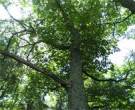
A small, gray squirrel stopped his running about one day to say hello to his friend and provider, the great oak tree in the wood. Scampering up the rough, whitish trunk, he sat among the many branches, sighed and said “you are so strong – so tall – so old – you have seen much in your many years here in the wood – but don’t you ever want to run about like me, to play, to jump, to climb?”

After a moment, while the wind played softly among the leaves of the old tree, the oak replied quietly… “I am oak.”

The small, gray squirrel nodded knowingly (or at least as knowingly as the small brained rodent could nod). He said to the oak, yes, yes, yes you are oak, but really aren’t you even curious to see what is over the next hill, beyond the woods, where I can go whenever I want? Oh yes, I remember you telling me how your roots intermingle with the other trees in the forest and you do know what lies around you for many hills – but come on, wouldn’t you just like to get up and go see it for yourself?”

After a moment, while the wind played softly among the leaves of the old tree, the oak replied quietly…

I am oak.”

Slightly exasperated the small, gray squirrel said, yes, yes, yes I know you are oak, but aren’t you at all sad when you drop all your acorns and most of them are eaten by my brother squirrels, and those ridiculous little white-footed mice, the rabbits and even the very hungry bears? Most of your seed never sprout and grow into oaks like you – oh, well except for once in a while when I forget where I’ve stored my winter supply, and they sprout in the spring. But, but even then those small sprouts of oaks rarely grow up – most are eaten by deer or mice before they see one winter. Oh yes, I remember you telling me how you feel complete when you can be of service to others, giving of yourself that they might grow and live. But come on really, wouldn’t you like to see more baby oaks around here?  Wouldn’t ya? Wouldn’t ya?”

After a moment, while the wind played softly among the leaves of the old tree, the oak replied quietly…

I am oak.”

After a long slightly angry pause, the excited little gray squirrel thought of something that would surely elicit a more satisfying reply than “I am oak” – from the oak. With a scheming glint in his eye, the little gray squirrel said to the oak, “so what about those humans, huh?” He thought he felt a slight shudder in the trunk of the great tree, but it may just have been the wind. What do you think of their saws and bulldozers and trucks? What do you think you would do if you saw a human approaching, measuring (as they always do), looking you over with the eye of the hunter, desirous, greedy, murderous, what then? Would you be so generous then? You who love to give of yourself then – what would you say to that? What about those humans…. huh? huh?”

After a much longer moment, while the wind played softly among the leaves of the old tree, the oak replied quietly…

I am oak.”

With that, the little gray squirrel decided this game was no longer fun, he jumped to a lower limb and back to the ground, and just ran off without even saying goodbye. The oak took a deep breath and seemed to smile.

As time passed, the oak did as the oak always did and was content in his place – breathing the clean air, taking nourishment and water from the soil, dropping acorns in the fall for the many animals that lived at his feet. Dropping leaves in the winter to replenish the soil – in thanks. Occasionally the oak noticed a small sprout from one of the acorns the silly squirrels had planted and forgot, but always a deer ate it before it saw one winter. The oak didn’t mind, he was oak and that was his place. Once in a while he thought about the question of the human, but not having seen one for a long time he chose not to wonder, but just to breath, to grow slowly in place, to be oak.

One day as it happened, he heard a strange sound. Yes, it was a vehicle of some sort – which meant one thing – a human. He heard, well really he felt the on-coming presence of the human, measuring (as they always do), looking about with the eye of the hunter, desirous, greedy, murderous (you see, he did remember the words of the excited little, gray squirrel). As the human approached, the oak became curious. This man had no saw, no bulldozer, no truck. In fact, he looked fairly harmless, all in all.

The man approached the mighty oak, stopped, looked up, breathed deeply – and seemed to smile. Yes, it was a smile, but he was not measuring, he didn’t quite have the eye of the hunter, he didn’t appear desirous, greedy or those other things the squirrel had talked about. The man simply stood quietly before the oak – breathing the same air as the great tree, the small animals, the earth.

Slowly, with a voice full of quiet gratitude and much love the man spoke. “Spirit of the oak, I honor you you have lived long and seen much. You have felt the wind and the rain, the warmth of summer, the cold of winter. You have fed the earth with your leaves and the animals with your acorns for many, many years. My people honor you and all you have given. You are indeed oak.”

The oak wondered, how could this human – understand?

The human continued slowly “I come from a tribe that wishes to build a new home for a young family in our village. We come here to ask your permission and forgiveness. We wish to take your mighty trunk for timbers for a new dwelling that will stand for many years. We wish to make furniture of your limbs, to be used and admired in this home for many generations. We wish to take your many branches for the fire, to warm this home. We have come to thank you for your gifts to the soil, to the little animals, and to ask your permission to allow us the greatest gift you have – your self – for our needs.”

The oak breathed deeply.

The man breathed deeply.

The earth breathed deeply.

The man then said, I will return when you have dropped your leaves to feed the soil and your acorns to feed the many animals. At that time, I will seek your reply. The man left.

The oak signed.

As time passed, the oak did as the oak always did and was content in his place – breathing the clean air, taking nourishment and water from the soil, dropping acorns for the many animals that lived at his feet. Dropping leaves to replenish the soil – in thanks. He noticed one small sprout from one of his acorns had grown in a place that seemed to have more light and had not yet been eaten by a deer. Perhaps this one would grow? Perhaps this one would be the one?

And the man returned, as the oak knew he would. Once again the man stood before the great oak, smiling in appreciation – breathing the same air as the oak, and the animals, and the earth. After a time he said with a quite, grateful, loving voice “will you become part of a home for a young family in our village, part of the furnishings in this home, part of our lives, to be admired and appreciated for many years? Will you heat our homes so that our children can be warm? Will you give us permission and forgiveness for ending your time in this wood?”

The oak breathed deeply.

The man breathed deeply.

The earth breathed deeply.

And the great oak replied with acceptance and love…

I am oak.”


Lets all support this local cooperative!

Lets engage our imagination.  Imagine a vital local market, a place where people invest and support and love helping to nurture locally owned farms and small businesses.  A place where the soil is shepherded for the benefit of generations to come; where seeds of inspiration are planted for developing a thriving economy through locally owned small businesses.

Imagine a collaborative community of residents and visitors where people work together to create a resilient local economy and a vibrant cultural vision.  Imagine a cooperative marketplace that offers lots of locally grown and locally made products, owned by producers and consumers.

If you can imagine this place, perhaps you’d be willing to help us make it a reality!  You don’t have to shop at this store to help.  You too are invited to be a member.

We have a location identified and are asking for memberships to help us acquire the Souper Bowl restaurant in downtown Amherst, Massachusetts. 

It’s a FABULOUS site for the producer-consumer cooperative, which will be called All Things Local.  Big enough for farmers and local craftspeople to each have their own marketplace spots. Small enough to be downtown. It includes a walk-in cooler to store farmer’s produce and dairy products. It has a commercial kitchen for a cafe, cooking demonstrations, and food canning and preservation parties!

But we have a deadline – July 31, 2013!  That is the date we must sign the lease or lose the store. We didn’t expect to find such a great location on such short notice!  But with your help, we can join together as coop members to secure the site.

Will you help?

Join the coop. A $50 membership makes you an founding member of the coop, with full membership benefits.  Just click on “Become a Member” and use Pay Pal to send in your membership fee….

Lets imagine All Things Local again….. a place where everything has local roots (from pears to pickles, sweaters to soap), where people can shop at a convenient year-round location featuring many producers and pay at a register operated by a local resident.  Imagine supporting this vision.

Our core idea being developed is the creation of a diversified, resilient, local owned community market, by employing a cooperative model with lower costs and shared-risk. The store’s design makes it:

Easy for buyers to buy:

  • Convenient location and hours
  • Year-round and indoors
  • Ability to pick-and-choose among many local producers
  • Single checkout, with all the usual payment options

Easy for producers to sell: 

  • Producers set their own price
  • Most of the selling price goes back to the producer where it belongs (no brokers or middle-men)
  • Fast drop off
  • Don’t have to be onsite (lower staffing costs)
  • Online pre-sale bulk orders
Like a year-round indoor farmers’ market
  • items sold by producer, in an information-rich setting
  • prices set by the producers themselves
  • 75%-85% of sales price is paid back to the producers
A community owned cooperative
  • joint governance by producer and consumer members
  • low sales commission covers overhead & staffing
  • volunteerism keeps prices down, and builds connections

Isn’t this the sort of business you’d like in your neighborhood as we all work toward alternatives to industrial farming.  Well, the likelihood of an All Things Local store in lots of places, depends on the success of this one.  Please help us make it real.

Join today and change a little part of the world “one co-op at a time”.

===============================================================================

For more ideas, videos and challenges, please join my Facebook Group; Just Food Now.

Is industrial food safe to eat?

On March 14, 2009, speaking about the number of incidents of food borne illnesses in the U.S., President Barak Obama reported on…

“…a troubling trend that’s seen the average number of outbreaks from contaminated produce and other foods grow to nearly 350 a year (up from 100 in the early 1990’s).” 

On that date, President Obama announced new FDA appointments and “tougher food safety measures.”  Since that date, the problem has gotten worse!

I used to get regular email updates from the Food and Drug Administration on food recalls because I was curious about the trend.  I discontinued the service, as there were just too many to follow, but if you are interested you can see the food recalled over the past 60 days at the FDA Recalls, Market Withdrawals, & Safety Alerts web page.  Its scary!

Most recalls don’t get much public attention (unless lots of people get sick or die) but the FDA issues a press release for each recall.  Here is a recent example of a recall of cherry tomatoes sold from a farm in Florida.

June 7, 2013 – Alderman Farms Sales Corporation, Boynton Beach, Florida is recalling one pint containers of Certified Organic Cherry Tomatoes because they have the potential to be contaminated with Salmonella, an organism which can cause serious and sometimes fatal infections in young children, frail or elderly people, and others with weakened immune systems. Healthy persons infected with Salmonella often experience fever, diarrhea, nausea, vomiting and abdominal pain. In rare circumstances, infection with Salmonellacan result in the organism getting into the bloodstream and producing more severe illnesses such as arterial infections (i.e. infected aneurysms), endocarditis and arthritis. This recall notice is being issued out of an abundance of caution.

Are you concerned?

Most food recalls involve processed foods like soups, cookies, cereal, cheese and brownie mix.  Salmonella, E. coli and Listeria are common problems in the industrial food system, showing up every few days in some products.  Many recalls do not involve health problems but may simply be triggered by mislabeling or products that are missing a label for a potentially harmful ingredient such as walnuts or pine nuts.  Nevertheless, the number of life-threatening problems continue to grow.

Just over the past five years, we may remember:

  • The “great salsa scare” of 2008 in which consumers were warned not to eat tomatoes or peppers believed to be contaminated with Salmonella.  Starting in Texas and New Mexico, eventually over 1,400 people were sickened in 43 states.
  • Within a month of the salsa scare, 30 million pounds of peanuts were recalled from stores and institutions due to Salmonella and 700 people fell ill across the nation, while 9 died from the contamination.
  • E. coli was believed to have contaminated Nestle Toll House refrigerated cookie dough. Nestlé recalled its products after the FDA reported that raw cookie dough sickened at least 66 people in 28 states.
  • You may remember when 500 million eggs were recalled after dangerous levels of Salmonella were detected in the eggs of two Iowa producers. Nearly 2,000 illnesses were reported between May and July, 2010.
  • Hundreds of people were made sick by cantaloupes sold by a Colorado farmer contaminated with Listeria in the fall of 2011.
  • Regular reports on E. coli were made in 2012 on contaminated spinach and other leafy green vegetables.
  • In 2013, 224 persons infected with the outbreak strain of Salmonella on whole chickens have been reported from 34 states.

Are you concerned yet?

Anyone who pays attention to the news won’t be surprised by this pattern of food borne illnesses, yet this is not something most people think about very often.  Most food illnesses are caused by under-cooking or sloppy preparation.  But contamination of food in the industrial food system at the source  (farm or factory) or along the long chain of handlers, processors, shippers, and retail distributors is a serious and escalating problem, in spite of increased efforts by the Center for Disease Control and the U.S. Food and Drug Administration to prevent, monitor and report these problems.

Our government offers lots of advice on how to handle food at home to reduce the likelihood of a problem.  They even tell us how to try to remain safe while eating out. One thing our government agencies won’t tell you however is that if you want to eat safe – buy local. 

You have a choice!

As long as the industrial food system is built on the assumption that it must be fast and cheap to be successful, this problem won’t go away.  Increased inspectors can’t prevent the industrial system from getting us sick!  But you have a choice.  Local farmers must work hard to make sure the food they sell is safe, since they know their customers personally!

According to Grace Communications, “by buying locally, you can increase your chance of getting a fresh, high-quality product. Local farmers may invite you to visit the farm or talk about any food safety concerns that you may have. Most importantly, if you buy close to the source, you can help create local food systems, which are the exact opposite of the quantity over quality kind of food production that has created many of the food safety problems described above. To find a farmer near you, visit Eat Well Guide.”

Who do you trust?

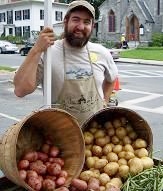
Just look into the eyes of the farmer selling you potatoes, lettuce or pasture raised beef the next time you go to the farmers market, and ask yourself – who do you trust? 

Do you trust the industrial food system, dominated by multinational corporations with their primary focus on making more and more money for stockholders –  or my friend Jeremy from Simple Gifts Farm in Amherst, Massachusetts?

You have a choice…..

===============================================================================

For more ideas, videos and challenges, please join my Facebook Group; Just Food Now.    You may be interested in the 15-credit Certificate, the 2-year Associate of Sciences degrees or the 4-year B.S. Sustainable Food and Farming major in the Stockbridge School of Agriculture.

Do public land grant universities serve the public good?

As the University of Massachusetts celebrates its 150th year (the “sesquicentennial” –  a word I can’t pronounce) there have been speeches and events and lots of discussion about our heritage as a land grant university.  This seems to me to be “all good.”

We recently had a groundbreaking ceremony establishing a new Agricultural Learning Center for example, within walking distance of the dorms and classrooms of campus, with the intention of providing students experience growing their own food.  There are lots of changes at “Mass Aggie” of late!

Again…. all good!

And yet, I wonder how many faculty, students and administrators are truly committed (or even understand) our land grant heritage.  This post explores our heritage and the commitment of the public land grant university to serve its public mission.

First, “land grant” is not about land…..  or at least, not in the way that many people associate the words “land grant” with farming.  While it is true that most of the original land grant universities were committed to scientific education for rural America and therefore developed agricultural research and education programs, “land grant” in fact, refers to the means of funding those universities.  Grants of federal land (mostly in the western United States), were made available to each state to sell in order to establish the first public colleges, the University of Vermont, and Kansas State University (which was the first public university established under the Morrill Act of 1862), and the University of Massachusetts.

According to the UMass webpage…. “UMass Amherst was born in 1863 as a land-grant agricultural college set on 310 rural acres with four faculty members, four wooden buildings, 56 students and a curriculum combining modern farming, science, technical courses, and liberal arts.”

Agriculture was indeed important to these public universities, primarily because while the urban areas of the nation were experiencing rapid growth and the beginning of prosperity, the rural areas were being left behind.  As a service to the larger public good, universities were established to help those in most need…. who happened to live in rural America and of course earned their livelihood farming.

Today, if we celebrate our land grant heritage as a commitment to farming, we are missing a deeper understanding of the mission of the public university to serve the public good (including farming, of course).  My concern is that after all of the celebrations of our agricultural heritage are over, the general public may be left with a question – so why are we still investing in a public university if their mission is to serve such a small percentage of the population (the farming community)?

Please don’t get me wrong….. I think it is important for the university to be proud of its heritage and continue to support agricultural research and education.  But I think the rationale for this support must be deeper than nostalgia for a time gone by.

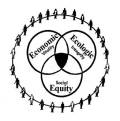
We must recommit to serving the public good and in doing so continue to grow 21st century agricultural programs focused on the three sustainability objectives of economic vitality, environmental integrity, and social equity.  It is only by clearly articulating a commitment to a more sustainable agriculture that we may continue to expect public support!

There are many forms of agriculture in the world.  The dominant form is “industrial” in the sense that it is economically efficient and highly technical, and leaks toxins from their point of application, uses natural resources such as fossil fuel and water at rates greater than replacement, puts farmers and ranchers off the land, and results in an overfed but poorly nourished citizenry.  I believe we must be clear with the citizens of the Commonwealth of Massachusetts that this is NOT the sort of agriculture we support at the land grant university.

This is about the public good!

A clear understanding of how the land grant organization serves American citizens, those today and those yet to be born, is key to the future of the institution.  Most people agree that the system has an obligation to serve the public.  But we have difficulty talking about “who is the public ‑‑ and what is the public good?

Many of our research and education programs are designed not to serve “the public” but to serve particular publics, or special interest groups.  I propose that there are interests, common to all people which we might call “basic human needs” such as:

  • affordable and nutritionally adequate food;
  • adequate clothing and shelter;
  • a healthy, livable environment free of violence;
  • opportunities to provide for one’s livelihood; and
  • accessible educational opportunities.

Our teaching, research and outreach should serve these larger public goods by working with the farmers, consumers and communities dedicated to building a more local food production and distribution system.  This is truly “public work” and is consistent with a commitment to a more sustainable agriculture.
Students seem to have noticed the change at the University of Massachusetts, as the enrollment in our Sustainable Food and Farming major has grown from 5 students in 2013 to about 85 today.  Things are changing at UMass, and I’m hopeful that our commitment to our public mission will be sustained.

What do you think?  Please share your own thoughts in the comments box below.

===============================================================================

Please share this post with friends.  For more ideas, videos and challenges, please join my Facebook Group; Just Food Now.   And also check out more World.edu posts.  You may be interested in the 2-year Associate of Sciences degrees in the Stockbridge School of Agriculture or the 4-year B.S. Sustainable Food and Farming major or other 4-year majors.  The UMass Extension program provides access to university resources to the citizens of the Commonwealth.


The Graduation Day Question

It’s that time at universities when faculty have the privilege of meeting the families of students we have known for several years.  It’s a time of celebration, transition, and that “dreaded” question from family members….. “so now that you have a college degree, what are you planning to do with it?”   The implication of course, is that the primary purpose of a college degree is for “job preparation.”

As a parent of a recent college grad, I can certainly relate to the relief (the kid finished!) and the anxiety (now what?) that parents experience.  Most of us parents with recent grads are smart enough not to ask the “now what” question on graduation day.  We know that we will have other opportunities to explore this sensitive issue, especially since most college grads end up living back home for a while.  It is often the uncles and aunts (who don’t see the grad very often) who ask the dreaded question.  This can be a moment of tension and awkwardness, since most graduates really don’t know!

The “now what” question is especially difficult for my students.  I am the faculty adviser for the Sustainable Food and Farming major at the University of Massachusetts.  My students feel called to grow food or be involved in some aspect of the local and regional food system, but often have not yet clearly identified a particular career.  Our recent graduates generally find themselves working on local farms, managing community markets, or interning with non-profit advocacy or community development organizations, while they explore opportunities in the local food system (here are a few examples).  It can be rich and rewarding work – but really difficult to explain to “Uncle Robert and Aunt Sue.”

Inevitably, when Uncle Robert learns that our student transferred from her original major of Biology or Environmental Science into Sustainable Food and Farming, he will look at the graduate with a confused look on his face, and say something like “so you want to be a farmer?”  After a short pause, he then says “Can you make any money doing that?” And finally, “isn’t farming hard work?

Of course, this uncomfortable experience is not unique to agriculture majors.  Any recent graduate who is not a business major or pre-med may be able to relate.

So you want to be an anthropologist?   ….a writer?   ….a community organizer?  ….an artist?    ….a philosopher?”“Can you make any money doing that?”  

Many people have a relatively shallow understanding of the purpose of higher education.  Certainly we should expect college to prepare students to be employable.  But we should expect much more from a college education than simply to be prepared for an entry level job in some corporation or business.  College should help prepare students for both a livelihood AND a rich and satisfying life.

The questions, “what will you do with your college degree?” and “can you make any money doing that?”  are the wrong questions to ask a recent grad.  While certainly understandable, a thoughtful uncle or aunt might consider trying to start a more meaningful conversation with a different question.  Here is the one I suggest…

“So, how do you plan to be of service to your friends, family and community or perhaps the larger world?”

Yes, I suggest Uncle Robert ask his big question not about career or money but about service.  There is plenty of sociological research, native wisdom, and just plain common sense that support the basic fact that people who live for service have more fulfilling lives than those who live their lives to accumulate consumer goods.  This is such a fundamental truth of human existence that the bible quote (Timothy 6:10) “the love of money is the root of all evil” is a cliche.  We all know this to be true, yet Uncle Robert still feels compelled to ask “any money in that field?

So I ask all the “uncles and aunts” and other family members of recent grads to please try to “raise the bar” and challenge the recent grad to be more than just a money earner.  This is your chance to join Plato and Aristotle (really) in placing the human experience within a larger context, which the ancients called The Great Chain of Being.  The chain starts with the divine (God) and progresses downward to the angels, stars, moon, kings, princes, nobles, humans, wild animals, domesticated animals, trees, other plants, precious stones, precious metals, and other minerals.  Get it?   —  This 16th century picture depicts the Great Chain.

Today we understand that The Great Chain of Being as a rough approximation of a natural hierarchy (which I’ve written about here earlier).  The lesson we can take from this powerful visual metaphor that goes back over 2500 years is that all aspects of the universe are interrelated in a specific way.  The short version of the interrelationship rule is “we look up for purpose and down for function.”

That is, the “lower” levels find purpose in the “higher” levels of the hierarchy – but the “higher” levels are dependent on the “lower” levels for function.  As a human, I look for function at the “lower” levels (animals, trees, other plants, precious stones, precious metals, and other minerals).  AND (this is the critical lesson)….. as a human, I look for purpose and meaning in my life at levels of complexity “greater than myself.”  That might be in friendships, family, community, Mother Nature, or perhaps the divine.

This is where Uncle Robert’s big question comes in……  “So, how do you plan to be of service to your friends, family and community – or the larger world?”  This is a question rooted in a deep understanding of human experience (going back to Plato and Aristotle).  It is challenging and respectful….. and much more interesting than “any money in that field?

Why not give it a try with a recent grad?

And finally, congratulations to all of the graduates of the Sustainable Food and Farming major in the UMass Stockbridge School of Agriculture!

=================================================================

I’d appreciate it if you would share this post with your friends.  And for more ideas, videos and challenges along these lines, please join my Facebook Group; Just Food Now.   And go here for more of my World.edu posts.  If you are interested in the major that prepares students for BOTH a livelihood and a rich and meaningful life, check out the Sustainable Food and Farming major a UMass.  Please note that jobs ARE important and I’ve written about finding good work here.

UMass to sign the Real Food Challenge!

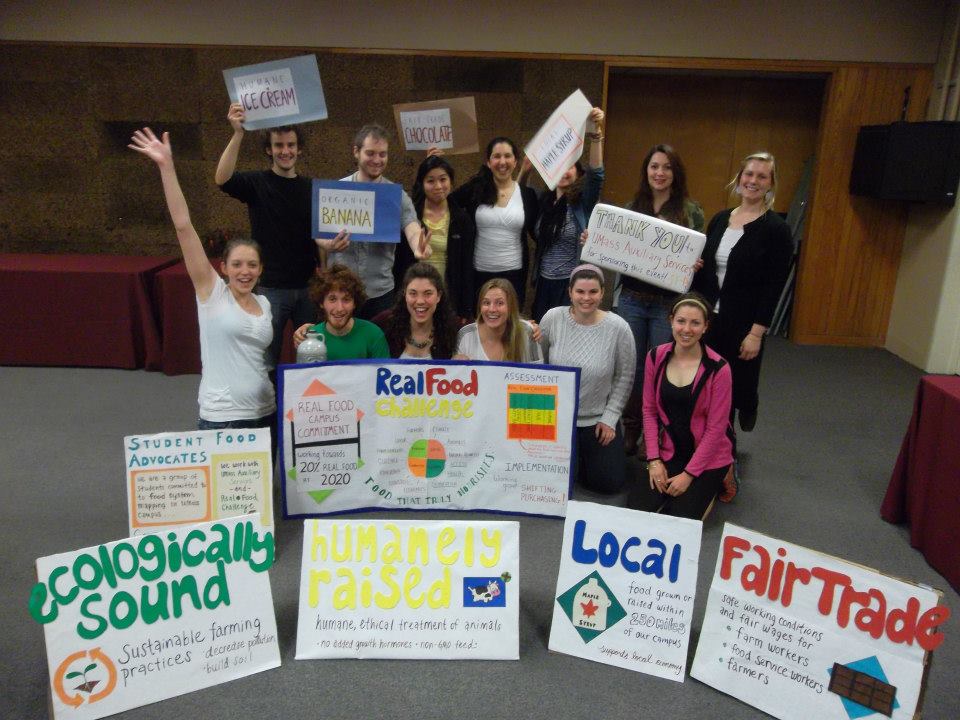
The Chancellor of the University of Massachusetts at Amherst, MA has agreed to sign the Real Food Challenge.  This will make UMass the largest university in America (serving about 40,000 meals per day) to sign the agreement committing the institution to assuring that 20% of the universities’ food purchases come from socially responsible farms and food businesses–what they call ‘real food.’

The Challenge was introduced to UMass in January 2012 with a presentation by the Real Food Challenge regional team in our Sustainable Living class.

Following this presentation a small group of students began to meet with university faculty and the Chancellor’s Sustainability Committee to begin to explore the possibility of making this commitment.

The Executive Director of Auxiliary Services and the person responsible for managing food services on campus, Ken Toong (left in the photo), has made a major commitment to high quality, sustainable food, and was an immediate and vocal supporter of the effort.

Students mounted a petition drive, collecting names of other students, faculty and staff who were in favor of the university making a commitment to the Challenge and on May 1, met with University Chancellor Subbaswamy.  According to Sustainable Food and Farming major Molly Bajgot, “the Chancellor was enthusiastic about the proposal and we expect to host a public signing in the fall.”  The actual text of the commitment is linked here

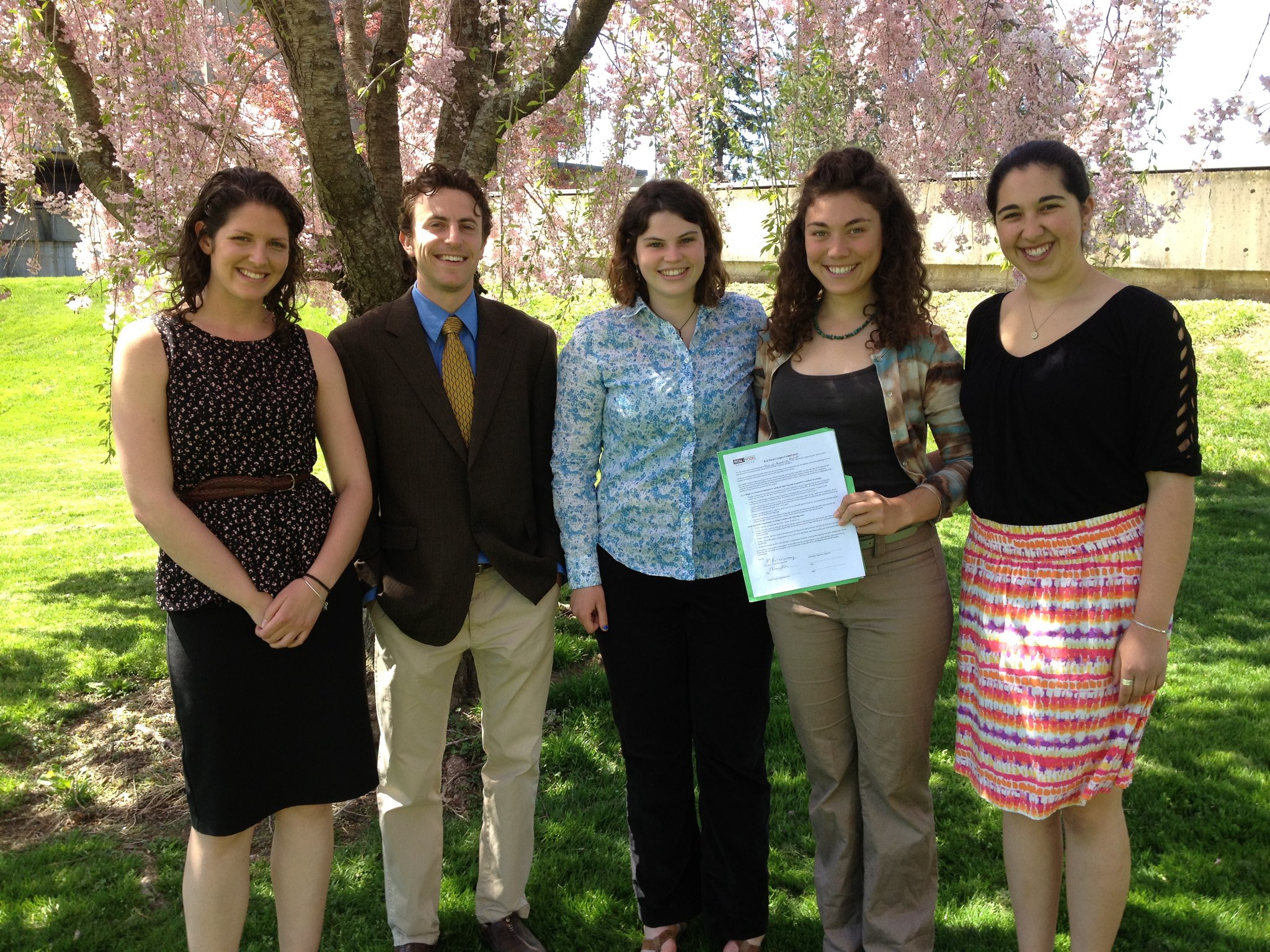
The UMass Student Food Advocacy team of (left to right in the picture below) Rachel Dutton, Ezra Small, Lila Grallert, Molly Bajgot, and Hannah Weinrock, should be congratulated for their hard work and perseverance.

Students in the project earn credit from the Stockbridge School of Agriculture to review invoices from hundreds of food vendors, investigating their commitment to Real Food.

According to Real Food Challenge leaders, “despite a growing interest in local, organic and sustainable food on campuses, little consensus exists on what makes food truly “good”…”  Further, they write…. “the youngest generation of Americans today will be the first in our nation’s history with a shorter lifespan than their parents, thanks in part to the food they eat.  Our food system is driving an epidemic of diabetes and diet-related disease, while also fueling climate change and the loss of our nation’s family farmers. The challenge is there’s just not enough ‘real food’ out there – it’s less than two percent of our national food economy. Fortunately our nation’s colleges and universities are uniquely positioned to address these 21st century challenges and help build a truly healthy food economy. With a combined annual purchasing power of almost $5 billion, U.S. colleges and universities have the capacity to significantly impact our nation’s food system through their decisions. Further, by educating students—our future CEOs,politicians, parents, and (yes!) farmers — we can cultivate the leadership and the ingenuity needed to successfully transition to a healthier, more sustainable food system.”

This student-led campaign is an example of how the University of Massachusetts at Amherst is leading the nation in creating opportunities for small, local farmers and encouraging change in the industrial food system.  Other projects and activities at UMass along these lines are:

  1. The UMass Student Farming Enterprise is a yearround class that gives students the opportunity to manage a small organic university-owned farm and sell their produce through a CSA, farmers market, and to university and private food service and retail markets.  See the video!
  2. The UMass Permaculture Initiative is a unique class and program that has converted underused grass lawns on the campus into edible, low-maintenance, and easily replicable food gardens. See on of the program videos!
  3. Permaculture in the Pioneer Valley is a class, sponsored by the UMass Dining Services UMass Permaculture Initiative that designs and installs permaculture gardens off-campus in local elementary schools.
  4. A celebration of local food cooperatives was sponsored by Sustainable Food and Farming students introducing the UMass campus and students to work opportunities in local foods!
  5. There has been an “explosion” of interest in the Sustainable Food and Farming major, growing from only 5 students in 2003 to over 85 students today.

One of the most important aspects of student education is the emphasis on getting practical experience either with local farms and markets, or non-profit public policy and advocacy groups, and farm-based education collaboratives.  Practical education built on a solid foundation of biological and ecological sciences prepare students to explore creative options and good work Its surely a good time to be an “Aggie.”

=======================================================

Anyone interested in discussing this new major should contact Dr. John M. Gerber, Program Coordinator and Professor.  Many students have found the flexibility of the Sustainable Food and Farming major attractive.  Contact us or check out the major here and some videos presenting courses and topics of interest.

Hope springs from growing food

It’s spring again in New England and the gardeners are out in force. Most of my neighbors know I have a big garden, raise chickens, collect honey from my backyard bee hive and harvest greens throughout the winter in an unheated greenhouse.

So I often get the question (while walking Riley our dog), Why do you want to do all that work?  My first thought often goes to the reality of our current global situation, which in my mind includes the “perfect storm” of climate change, peak oil and economic downturn.

But rather than launching into my rap about the need for more community and family-level self-sufficiency in the face of this global crisis, I generally choose to tell my neighbor about a book I just read.

“Prelude” by Kurt Cobb is a fast-paced espionage story set in a time of escalating oil and gas prices. One of my favorite scenes comes when Cassie Young, a rising star at a Washington, D.C., energy consulting firm, asks a friend, Victor Chernov, “…so what do we do now that we know the truth about peak oil?”  For Cassie, this is a moment of despair, which many of us have felt.

And Victor’s response — grow a garden!  It seems this former oil executive is learning to grow tomatoes at his Washington, D.C. townhouse.

While not destined to become a classic, the appearance of mass market books like “Prelude” suggests we are beginning to accept the fact that we are facing an oil/climate crisis — and yes, at least one of the solutions might be to grow food for myself, my family and my neighborhood.

The author, a founding member of the Association for the Study of Peak Oil and Gas, proposes a simple response to the crisis we seem afraid to face. Cobb reminds us that “fear trumps hope” and finding a source of hope is a necessary first step toward developing solutions to a problem.

I believe that if we can’t imagine reasonable solutions to a crisis, then we are not going to face the problem – not matter how real and critical it may be. So yes, let’s grow more food. This might be anything from a single potted herb on a windowsill to a big family garden. For me, I like to give fresh eggs from my backyard hens to my neighbors.  One of my favorite local groups is Grow Food Amherst, which works to encourage others to grow food in my hometown, Amherst, Massachusetts.

We realize of course, that a potted herb plant, a few eggs or even bushels of tomatoes won’t solve global problems like climate change and rising oil prices, but it is a place to begin to find hope.

And with hope, anything is possible.

My neighbors often ask if I really believe the “perfect storm” was imminent.  So, I take a deep breath, give the dog another biscuit and launch into the “do it anyway” rap.  That’s the one that says that taking care of each other is a better way to live, even if there was no crisis. And if the perfect storm slams us sooner than any one of us would hope, at least we’ve begun to take some steps to be better prepared.

  • So yes, let’s learn to grow more food.

  • And let’s learn to cook real food.

  • And let’s buy from local farmers.

  • And let’s teach each other how to do all these things better by sharing our knowledge and experience.

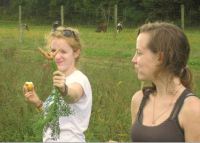
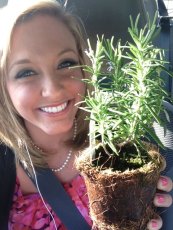
I was interviewed by a TV news reporter recently about my involvement with Grow Food Amherst, that encourages others to grow more food. I asked her if she had ever grown a garden and when I learned that she had not, I encouraged her to start with a potted herb plant on the windowsill – and she did.

In fact she sent me a picture of herself with her first food plant which she purchased on her way home that same day!  It’s a beginning!

===========================================================

Please check out my Just Food Now Resource Page and see our Sustainable Food and Farming page. Please share this blog with anyone who might be interested in either the Bachelor of Sciences degree or our 15 credit Certificate Program at the University of Massachusetts.

On Leadership….

Many organizations are over-managed and under-led. Daily routines are handled, but no one questions whether the routine should be done at all. Over time, the organization may find itself humming along efficiently, but not terribly effectively.  Outsiders begin to question the need for the organization – and a crisis in leadership ensues.  At this time of rapid social and economic change, leadership will help determine which organizations prove sustainable.   This post shares a few thoughts on effective leadership.

Dr. Robert Terry, former Director of the Reflective Leadership Program at the Hubert H. Humphrey Institute for Public Affairs of the University of Minnesota, presented six common views of leadership (and then adds a seventh) in his classic book, Authentic Leadership: Courage in Action.  The six common views of leadership are are follows;

  1. The first is called the trait theory. There are “born leaders” – like John Kennedy, Abraham Lincoln, Thomas Jefferson, and perhaps Barack Obama.
  2. The second type of leadership is called situational. Leaders respond to the situation – the war years “created” George Washington, Winston Churchill, and FDR. The “times create the man or woman.”
  3. The next leadership theory is called organizational. In this view, leadership is a function of position or rank in a hierarchical structure. This type of leadership is functional in many corporations, universities and of course the military.
  4. The forth view is the power theory, which suggests that position in a hierarchy isn’t as important as the ability to stimulate action. We all know people who passively occupy positions of authority, while people without impressive titles make things happen.
  5. Terry’s fifth type is called visionary. Leadership understands the past, scans current trends and helps point people toward a meaningful future. The visionary leader always asks the question “where are we going?”
  6. The sixth view, the ethical assessment theory, is also visionary, but it is a vision that involves ethical reflection. This leader not only asks “where are we going?,” but also asks “why are we going there?”

Terry believes that each of these six views of leadership is important, but incomplete. He proposes a seventh view that is a combination of all the others, which he calls the theory of fulfillment. In Terry’s view, leadership is exercised when people organize to engage and fulfill the needs of the people in the institution, while serving the mission and working toward a shared vision.

Terry’s seventh view is that “leadership is a particular kind of social and ethical practice. It emerges when persons in community, grounded in hope, are grasped by unauthentic situations, and courageously act in concert with followers, to make those situations authentic.”

I’ll restate the seventh view with some explanations in parentheses; “…leadership is a particular kind of social ( we are people in communities) and ethical ( thinking and acting for the sake of others) practice ( leadership is doing). It emerges when persons in community ( together), grounded in hope ( things can get better), are grasped ( see and called forth) by unauthentic situations, ( something is wrong), and courageously ( it won’t always be popular) act in concert with followers ( together), to make those situations authentic ( right).

Leaders are visionaries, dreamers, idealists – with their feet firmly planted on the ground. Effective leaders nurture a shared vision within the organization. They do this by constantly acting on their vision.

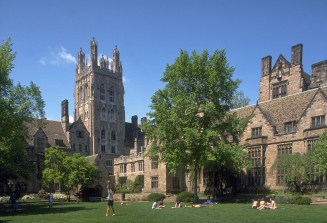
I’ll conclude this essay with two examples of visionary leadership. On the day that A. Bartlett Giamatti assumed the presidency of Yale University (July 1, 1978), he sent the following memo to the Yale faculty:

******************************************************************************************

In order to repair what Milton called the ruin of our grand parents, I wish to announce that henceforth, as a matter of University policy, evil is abolished and paradise is restored.

I trust all of us will do whatever possible to achieve this policy objective.

********************************************************************************************

I’m sure “the abolition of evil and restoration of paradise” is indeed a worthy vision. The only problem is that it wasn’t shared. The Yale faculty were shocked and upset by their new President’s lack of decorum.

Leaders must recognize the “boundaries” of institutional vision. Warren Bennis wrote in his book, Leaders: “…vision should be projected in time and space beyond the boundaries of ordinary planning activities – but not be so far distant as to be beyond the ability of incumbents in the organization to realize.”  Bennis suggests that: “boundaries are set by the values of the people in the organization.”  Sometimes leaders don’t recognize the boundaries until they are crossed. Giamatti crossed the line his first day on the job.

The second example is a truly shared vision from a slave rebellion in 70 BC against the Roman Empire. When the Roman General Crassus told the outnumbered slaves if they turn over their leader, Spartacus, they would not be punished (remember the 1960 movie with Kirk Douglas), each of the former slaves stood up, stepped forward and shouted out to Crassus “I am Spartacus.”

Now that was a shared vision.

===========================================================

Please check out my Just Food Now Resource Page and see our Sustainable Food and Farming page. Please share this blog with anyone who might be interested in either the Bachelor of Sciences degree or our 15 credit Certificate Program at the University of Massachusetts.

Antibiotic Resistance at Factory Farms "Scares the Hell Out of" Scientists

The headline above caught my attention when it first appeared in 2009.  Johns Hopkins University Scientists declared that antibiotics should be banned from animal feed.  If we didn’t take action, they warned we are likely to see an explosion of human deaths from previously preventable bacterial diseases as antibiotics become less effective.  I was sure this news would result in a public uproar….. I was wrong.   So when the latest news reports on antibiotic resistance appeared outlining the potential crisis in human healthcare, I had to wonder – maybe this time?  Will there be a public outcry about the use of antibiotics in the animal industry now?  Well, not yet!  But here is what the scientists are saying about the declining effectiveness of antibiotics.

While we have known this is an emerging global problem for some time, recently the medical profession is talking about a “catastrophic threat –  as big a risk as terrorism.”  There seems to be two point-sources for antibiotic resistance; one is hospitals which need antibiotics to safely do even simple surgeries.  The other place antibiotic resistance is developing is CAFO’s (concentrated animal feeding operations) or “factory farms.”

A well-documented report on the use of antibiotics in factory farms states:

Animals live in close confinement, often standing or laying in their own waste, and are under constant stress that inhibits their immune systems and makes them more prone to infection.  When drug-resistant bacteria develop in industrial livestock facilities, they can reach the human population through food, the environment (i.e., water, soil, and air), or by direct human- animal contact.  

In response to this problem, the FDA asked the animal industry to voluntarily reduce the amount of antibiotics used in factory farms.  The Animal Drug User Fee Act (ADUFA) requires drug companies to report the amount of antibiotic drugs sold or distributed for use in food-producing animals (although the industry seems to be fighting back to keep this information out of public eyes).  So how did the animal industry respond to this reasonable request?    A recent report of the Pew Charitable Trusts (a reputable group) reported that antibiotic sales for meat and poultry are soaring!

If we have known about this problem for a long time, why is nothing being done?  Last November, several hundred thousand citizens, including many senators and congressmen, urged the FDA to take action. It is doubtful however than anything will change without a public outcry. Pew Health Initiatives asks you to take action! They write;

On April 16, 2013, Pew will be hosting the second annual Supermoms Against Superbugs Advocacy Day. Concerned moms, dads and other caregivers will come to the nation’s capital to lobby the U.S. Food and Drug Administration, Congress and the White House to rein in the overuse of antibiotics in meat and poultry production – a practice that breeds dangerous superbugs that can infect humans.  Learn how you can get involved

There is a safe way to raise animals for meat without antibiotics!  You can make a clear statement of support for changes in legislation by signing the petition here refusing to buy meat products produced in a factory farm.  Learn more about the safe raising of animals and find producers non-factory farmed meat at Eat Wild or at your local farmers market!

===========================================================

I’d appreciate it if you would share this post with your friends.  If you are interested in sustainable food and farming, please join my Facebook Group; Just Food Now.   And please check out more on my personal webpage.

Systems Thinking for a More Sustaianble World

New Thought Evolutionary

Creating The Beloved Community - Together

Amadou It All

A Fascinating Fungal Fabric and a Humungous Human History

Levi Stockbridge Lessons and Legacy

What can we learn today from "Prof Stock"?

The Niche

Trusted stem cell blog & resources