The perfect storm: Global pandemic

Last week’s blog focused on one of the three big problems of our time, Peak Oil. This week we are looking at the threat of Global Pandemic caused at least partially by industrial animal agriculture (factory farms). According to the Director General of the World Health Organization, the three major problems of our time are:

  1. Peak Oil
  2. Global Pandemic
  3. Climate Change

There is evidence that the bird flu and swine flu epidemics of the past few years originated in factory-farms in Southeast Asia and Mexico.  The industrial response to bird flu was typical of modern culture – proposals to irradiate meat, flu vaccines for the birds, efforts to outlaw backyard chickens.  The real problem is the system we have created to make sure our meat products are cheap – factory farms (these are “structures” in our iceberg tool that we use to understand root causes).   Perhaps an even more immediate concern however, is the potential loss of antibiotics for human health care due to their extensive use in factory farms.  If you WANTED to create antibiotic resistant bacteria, this is how to do it:

  1. Inoculate a petri dish with bacteria, which will grow like crazy
  2. Apply an antibiotic, which will probably kill 99% of the bacteria
  3. Feed the surviving 1% with sugar water, and it will “grow like crazy”
  4. Apply an antibiotic to the new growth, which will probably kill 99%
  5. Again feed the surviving 1% sugar water, and it will……

Do this again and again and again…. and what you end up with is a strain of bacteria that is resistant to antibiotics!  And this happens BY DESIGN in at least two places in modern culture….

In a  Johns Hopkins magazine article from June 2009….. Kellogg Schwab, director of the Johns Hopkins Center for Water and Health, spoke about samples he collected from a lagoon used to store pig manure. “There were 10 million E. coli per liter [of sampled waste]. Ten million!   And you have a hundred million liters in some of those pits. So you can have trillions of bacteria present, of which 89 percent are resistant to drugs. That’s a massive amount that in a rain event can contaminate the environment.”

He adds….

“This development of drug resistance scares the hell out of me. If we continue on and we lose the ability to fight these microorganisms, a robust, healthy individual has a chance of dying, where before we would be able to prevent that death.

Schwab says that if he tried, he could not build a better incubator of resistant pathogens than a factory farm.

This is crazy!

Lets use the iceberg tool again to try to answer the question “why do we do this to ourselves?“.

So, once again I asked my class…. “what is the root cause of this crazy human behavior?”

In this case, an event might be a single hog or chicken that was treated with a low level dose of antibiotic to help it grow faster.

A pattern would be thousands of chickens treated with antibiotics to keep them alive while living in a crowded, unhealthy environment.

The more interesting questions are about the structures and mental models that make these crazy behaviors “normal.”

Among the structures named were:

  • Concentrated Animal Feeding Operations (factory farms)
  • pharmaceutical industry
  • government regulation
  • advertising industry
  • fast food industry
  • what else?

And the mental models that make these structures “normal” might be:

  • a belief that everyone needs animal protein daily
  • the expectation that food should be cheap
  • the belief that animals are simply “units” not living beings
  • the worldview that humans are not part of “mother nature”
  • the hope that “government will protect us”
  • what other beliefs support this behavior”?

To change the patterns, we must change the structures used to raise animals.  But to change the structures, we must change the way we think (mental models). Take a few minutes to compare these two systems for raising chickens, and look for the mental models under each of these structures:

1. An industrial poultry farm

2. My backyard

The local farm or backyard option is a real possibility, but to change these structures we must first change the way we think.  And to change the way we think, we need to change the way we ourselves choose to live!  The following is a short video comparing the way we treat animals with the way we live our lives…..(can you see shared mental models?).
…………

To change the way we treat animals, we need to change the way we live our lives.  What are you doing to change your own life!

====================================

The perfect storm – Peak Oil

This week in Sustainable Living class here at UMass we are beginning to explore the root cause(s) of the three big problems of our times.   According to the Director General of the World Health Organization, these problems (which I describe as “the perfect storm” because they are interrelated and all happening at once) are:

  1. Peak Oil
  2. Global Pandemic
  3. Climate Change

This blog looks for the root cause(s) of our excessive use and dependence on oil, a problem described by the term “peak oil”.   Most students at UMass have heard the term (which was not true just a few years ago). But it is surprising how few can speak about  the root cause(s) of our excessive energy use, which has resulted in peak oil.  So in class, we introduce the topic with a short video, and then ask the students to use the systems thinking iceberg model (which I wrote about last week) to begin to understand the root cause(s) of peak oil.  Here is what we learned…..

M. King Hubbard predicted that oil production in the U.S. would peak in 1970.   And it did! This means that half of the extractable oil in the U.S. was burned by Americans over 40 years ago.  This is a problem!

Even the former-President of the U.S., George W. Bush, charged the nation with being “addicted to oil.” The first step in 12-step recovery programs is to admit that we have a problem.   Based on our behavior however, it seems that we are not willing to accept this truth.  Like other addictions, this one will end badly.

So, if it is obvious that being addicted to a finite resource isn’t a good position to be in, why aren’t we taking it seriously?  I believe that most of us find it difficult to face problems when we can’t imagine a reasonable solution.  And understanding the problem is the first step toward creating and accepting reasonable solutions.

So in class, we look for the root cause(s) of problems by using the iceberg.

When I asked the class to identify the structures that result in patterns of human behavior that cause us to continue to deplete fossil fuels at ever-increasing rates, they came up with the following list:

  • The oil industry
  • Automobile manufacturers
  • Advertising agencies
  • Vacation & Travel industries
  • Well, in fact almost ALL businesses….
  • The military
  • High gas mileage thresholds
  • Subsidies for the oil industry
  • The national highway system
  • Airports
  • Non-energy efficient buildings
  • Well, just about everything in our lives

Here is a short clip explaining how we determine structures, with a few more examples:

The more interesting question is what are the mental models (the beliefs, the assumptions, the stories we tell each other) that contribute to the creation of the structures that encourage the excessive use of a oil.  These are some of the mental models generated by the class:

  • Individual actions don’t make a difference
  • We’ll figure out what to do when things get really bad
  • The world is made for humans to use
  • I have the right
  • Shop till you drop
  • I need amusements to be happy
  • If I can’t fix everything….. I won’t do anything

Here is a short clip describing mental models, with a few more examples:

Why don’t you identify your own mental models from the video below and share your thoughts in the comments box.

……………..

What do you think is the root cause(s) of peak oil?

======================================================
Digging for the root cause(s) of global crises

Last week my Sustainable Living class at the University of Massachusetts explored Mother Earth’s three ecological rules for living sustainably.  They are:

  1. Use current solar income
  2. Waste = food (cycle everything)
  3. Support biological diversity

During the class, I briefly mentioned what happens when humans violate these rules.  The result is “collapse” as presented so well by these two classic texts, Collapse and The Lorax (which are basically the same book – well, one has more pictures!).

Both Jared Diamond and Dr. Suess knew that when a society outstrips its natural resource base (what was that old onceler thinking when he cut down the last truffula tree because “everybody needs a thneed“) ….. well, things get bad – its  the “perfect storm”!

LeopoldThere are many ways to analyze the problems we face today.  In Sustainable Living class, we  look for root causes of the events that make it into the newspaper.  In his 1949 book of essays, A Sand County Almanac, Aldo Leopold encouraged us to “Think Like a Mountain.”   I suspect a mountain would not notice the daily economic and political struggles of humans, but would focus on the underlying systemic patterns that result in social and environmental decay.

In class, I presented three global systemic patterns (“the perfect storm”) as the principle ecological crises that we must face – or collapse!  They are:

  1. Peak Oil
  2. Global Pandemic
  3. Climate Change

When we begin to look closely at these patterns, it is easy to become depressed and feel quite hopeless.  It is easy to blame others.  In Sustainable Living class we look for realistic and simple actions that students can take to begin to address these problems.  The first step is to try to understand the root cause of the patterns.

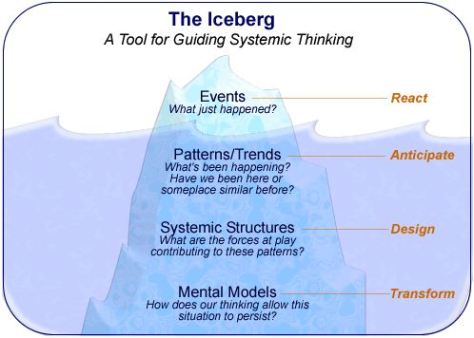
icebergpict1-250x239To begin to understand complex systems (like the entire planet and all of human civilization), we need some powerful tools.   I’ve been teaching courses related to systems thinking for some time and the most useful tool I teach is the “iceberg.”  This systems thinking tool helps us to “see below the surface” of daily events to begin to identify the root cause of systemic behavior.  Lets try it!

In the iceberg tool,  individual “events” are depicted as the tip of the iceberg, and visible to the naked eye.  But most of the iceberg is below the surface.

So we learn to look below the surface for the root cause of events.  Here is a simple example:

An Eventthere was a robbery in my neighborhood last week during which someone took a laptop computer and some loose cash from an empty house.  The break-in took place one evening while the homeowners were out to dinner.

The Patternthis has been happening regularly for several years!

Structure (these are physical things, organizations, policies and rituals that are relatively permanent and contribute to the pattern)

  1. Most homes in my town have been left unlocked day and night for years (ritual).
  2. It is easy to break a window (physical thing) and gain entry to most homes.
  3. Unemployment has risen dramatically over the past few years (a result of policies).
  4. The capacity of police departments (organizations) to patrol neighborhoods has been hampered by limited budgets (policy).
  5. Cuts in public support for education results in some people having less opportunity for good jobs (policy).
  6. Television and magazines depict “the good life” as one rich in material goods (policy).

Mental Models (these are the beliefs, worldviews, and assumptions that create the structures)

  1. “It won’t happen to me, so I won’t lock my doors at night” (homeowner).
  2. “People with homes can afford to loose a few luxury items” (robber).
  3. “Its probably just a few kids.  We’ll catch em soon.” (police).
  4. We can’t afford good public education or employment programs during this economic crisis” (conservatives).
  5. “You can have it all!” (the advertising industry).
  6. What else?  I”m sure there are many more.

This example describes how the iceberg model can be used to “dig deeper” into root cause of a social problem.  If all we do is “react to events” (such as an individual house break-in), the systemic problem (lack of education and employment, and material-rich expectations of “the good life”) will never be addressed.  Systems thinking helps us to uncover leverage points for the transformation of society necessary to deal with systemic problems.  Transformation must begin with a “mind change”…. that is, how we think.

Here is how we use the iceberg tool to “see below the surface.”

iceberg

==============================================================================

I’d appreciate it if you would share this post with your friends.  And for more ideas, videos and challenges along these lines, please join my Facebook Group; Just Food Now.

Gardening and living by three "ecological rules"

Spring semester is underway at the University of Massachusetts and I’m teaching a class called Sustainable Living with about 300 students.   My next several posts will share some of the lessons from this class.  My first lecture is called Ecology “Rules”.

The three ecological rules for living sustainably are:

  1. Use current solar income whenever possible.
  2. Recycle everything (waste = food).
  3. Encourage biological diversity.

This post looks at how we try to “obey Mother Nature’s rules” in my own household and garden and makes suggestions for you to consider in your own life.

1. Use Current Solar Income

Well, the obvious use of solar income growing food in the garden.

We have a big garden, with two unheated hoop houses that allow us to grow food during three seasons in New England.  But if you live in an apartment, you can still grow some food in planters and window boxes.  Or check with your town hall and ask about access to a community garden.  Or join a CSA (many deliver directly into the city).  But if you have a big back yard, why not try “food not lawns”.  Lawns require too much fertilizer and water and produce nothing.

A simple way to use solar energy is dry your clothes outside.   I enjoy feeling like I’m somehow beating the oil companies this way.  And while it is a small thing, I like to feel the sun on my back while I’m hanging the laundry out.

And if you own your own home, there is no better investment than solar hot water! 

Although, both oil and wood are originally solar, wood heat is much more “current” than oil and can be regenerated in a lifetime.  So we burn wood for supplemental heat.  It also provides a back up when the power goes out in a winter storm!

I suspect there are lots of other actions we could take to obey Mother Nature’s first rule.  Why don’t you add your own below in comments box?

2. Waste=Food

So, here’s the second rule…..  everything cycles, or “waste=food.”  And of course the easiest way to obey this rule is to compost food wastes.  We collect all of the organic waste (except meat) in a small bucket on the kitchen counter.  It goes out to a compost pile to turn into organic matter, which goes on the garden to grow more food.  In Mother Nature, there is no waste!

Some of the food “waste,” like old tomatoes, go to our hens, which turn that “waste” into fresh eggs.  Have you ever had a fresh egg?  It tastes different than the industrial version.

There are other ways to turn waste into food.  The ashes from the wood stove (waste) go onto the garden to grow more food.   Wood ash has potassium (potash), an essential nutrient for plants.

And how about recycling old newspapers and cardboard by using it as a mulch on the garden?   Non-glossy newsprint is safe and prevents weed growth, builds organic matter, and provides a great home for worms that turn leaves and garden residues into fertilizer.

The newspaper is covered with hay and then watered down.  We do this every fall to get the garden ready for planting in the spring.  We try not to rototill at all, since this kills the worms which help feed the garden.

3. Support Biological Diversity

And the third rule…… well, the first two don’t work well without biological diversity.  A monoculture, either a 1000 acre corn farm or your front lawn violates Mother Nature’s rules.  And the best way to mix things up in the garden is to make sure you have both plants and animals!   Animals…… really?

Well, yes.  Animals in the garden are needed to recycle nutrients.  Here are our “meat chickens” feeding (and pooping) in the old strawberry patch. 

Chickens are one of the easiest animal to include in your garden.  We raise 25 broilers each summer.  They are around for about 8 weeks and then “into the freezer.”  Lots of communities are working to change their zoning rules to encourage backyard chickens and hens for food self-sufficiency.

There is one backyard animal that is even easier than chickens….. that’s bees.  We harvest about 8 quarts of honey each year from our bee hive.

Oh sure, you say…. I can’t do that!  Well, its not all that difficult and there are lots of your neighbors who have already joined the “homegrown revolution!”

But if you are not ready for chickens and bees….. well, then start with worms.  Yup, that’s right.  They can help recycle kitchen wastes all winter long.

This little “worm condominium” supports a few thousand worms that quietly eat food waste, producing lovely potting soil.  And the hens love to have a few worms as a snack during the winter when the ground is frozen and they can’t scratch up their own bugs.  Try it!

The food waste goes in and the worms do the rest.  Its called vermiculture farming (worm) and its simple!

How are you obeying Mother Nature’s rules?  Post your ideas in the comments box below!

But I don’t want to “obey” the rules

There is a part of me that rebels when I hear the word “obey” or “obedience”.   But lets look more closely at that word “obey.”  It comes from the Latin “obedire“, which is to hear or listen.  Perhaps that is what it means to “obey” Mother Nature’s rules, simply to listen deeply.

I remember my first Permaculture course, when we we told to go out and sit in a garden and observe quietly.  I was surprised by the difference between this garden brimming with biological diversity (birds, bees and bugs) and my own which was productive but sterile.

When I sit and listen to Mother Nature’s “voice” I seem to become part of something much bigger than myself.  I can feel the energy of the earth and I feel at peace.   And yes, I try to obey the rules.

After all, these ecological rules have evolved over 4.5 billion years of evolutionary trial and error (or perhaps divine intent) on this planet.  Our own human cleverness isn’t working so well and seems to have gotten us into quite a mess.  Maybe we can learn something by listening to Mother Nature!

How do you live by these three ecological rules?

==========================================================================

I’d appreciate it if you would share this post with your friends.  And for more ideas, videos and challenges along these lines, please join my Facebook Group; Just Food Now.

Lets put the "public" back in the public university

Education for Sustainability should be a primary goal of public universities.  Here’s why…..

As someone who continues to believe in the original purpose of the U.S. land grant university system, I am particularly concerned by the present state of affairs. I”m told by some of my colleagues and a few administrators that I can’t talk about the “land grant ideal” because nobody believes in it anymore.  Well….. I do.

Sorry, but in times of severe financial stress I believe that a re-energized focus on creating and sharing knowledge in service to the public good remains our best strategy.

Some of our university leaders have taken a more pragmatic approach.  When public funds are not adequate to “keep the ship afloat”, they solicit help from private enterprise –  after all, they have they money!   My own university had a chancellor whose favorite phrase was “money matters.”

Clever…..  but I prefer “mission matters.” I hope we choose not to quit on the public mission of the university – not just yet.

I believe that our understanding of how the university serves American citizens, those today, and those yet to be born, is key to our future as a public institution. This blog explores what it might mean to be a university that serves the public good.

Most of us working at a public university probably have a notion that we have an obligation to serve the public – somehow.  But who is the public, and what is the public good?   Dr. Jeffrey Burkhardt, Professor of Agriculture and Natural Resource Ethics and Policy at the University of Florida, suggested that there are interests, common to all, which he described as “basic human needs.”  They are;

  • adequate, affordable, nutritionally adequate food;
  • adequate affordable, clothing and shelter;
  • a livable environment;
  • secure means to provide for one’s livelihood; and
  • accessible educational opportunities.

We should serve the public good by addressing these basic human needs, and thus optimizing for the environmental, economic and social well-being of the entire community.  Some of us call this educating for sustainability. It seems to me that research and educational programs which support the quest for sustainability should be a feature of every public university.  This is a legitimate use of public funds and an appropriate investment by local, state and national government.

Of course, public institutions should not be engaged in work that private enterprise can do better.   Public funded institutions must however take responsibility for providing goods and services that have a significant social benefit when they would not otherwise be provided by the private sector.  Public/private partnerships are also appropriate when they clearly serve the public. There are three categories of goods and services that are appropriate for public investment:

1.     Public good and services are those which can be used in a non-rival manner by all of society. Once created, these goods are available to all without additional cost. Private enterprise is unlikely to invest in goods used in a non-rival manner because it is difficult to capture a return on their investment. Knowledge created from basic research is an example of a public good which is more valuable to society than any one individual or company.

2.     Private good and services subject to market failure may have a value to individuals, but for which the private sector is likely to underinvest. Government may choose to provide such goods to individuals if they have significant social benefits. It is appropriate for public universities to provide a direct educational service to individuals when it also serves the larger community.  Environmental education is a prime example.

3.     Social welfare goods and services are provided by government for reasons of equity.  Educational programs for populations at risk, access to food, and the availability of education to all are considered social welfare goods.

These same guidelines should be used when we are considering public/private partnerships. We cannot afford to be engaged in work more appropriate for the private sector.

Public agricultural programs can serve the public good through research and educational programs on agricultural sustainability, food quality and safety, human nutrition, food sovereignty, and environmental integrity. This is just as true today as it was in 1862 when the land grant system was created by an act of Congress.  The Morrill Act established 69 colleges across the nation, paid for with grants of federal land that was sold to create the first public university system in the world.  This was a truly revolutionary act.

When President Abraham Lincoln signed the Morrill Act, he said: “The land-grant university system is being built on behalf of the people who have invested in these public institutions their hopes, their support and their confidence.”

If we have courage and vision, I believe we can lead the way back to the future and re-establish the financial support and the confidence of the American people – but only if we don’t quit on the public mission!

Lets put the “public” back in the public university by addressing the most basic of human needs.  Education for sustainability may be our best investment if we want to recommit our work in service to public good!

==============================================================================

I’d appreciate it if you would share this post with your friends.  And for more ideas, videos and challenges along these lines, please join my Facebook Group; Just Food Now.

On creativity and the sources of "new ideas"

A few years ago, I ran a cross a little book called The Use of Lateral Thinking by Edward DeBono.  I’d like to share some of Professor DeBono’s thinking on creativity and the sources of “new ideas.”

DeBono was a Maltese educator and thinker.  He has a Ph.D. from Cambridge University and has had faculty appointments at Oxford, Harvard, and Cambridge. He has consulted for academic institutions, governments, and corporations worldwide on educational theory and learning.  He has written 25 books on cognition, which have been translated 20 languages.

DeBono is given credit for the concept of lateral thinking, a tool used to create fresh ideas.  He claims that most ideas come from vertical or logical thinking, which may produce “an answer” but is likely to be inadequate in the face of new and complex “real world” problems.  Really fresh “new ideas” won’t emerge from logical thinking.

DeBono uses the image of digging holes to describe the quest for new ideas.  He says you can’t find the answers to new problems by using old ideas. Sometimes you have to dig in a new place.

DeBono writes:

“It is not possible to dig a hole in a different place by digging the same hole deeper.”

If we need new and creative solutions to emerging real world problems, it is unlikely that we will find them in our text books, classrooms, libraries, or even the scientific journal articles….. the ideas that we have “dug out of the old holes.”  An example of a new idea is the “communiversity” that I wrote about some years ago, and turned out to be just another new hole that was ignored by the university.  So why are new ideas so difficult to take seriously?

DeBono writes,

“…it is easier to go on digging in the same hole than to start all over again in a new place.”

University research and education programs are really good at digging in places that have proved successful in the past.  Institutions are designed to be conservative and giving up the old holes is difficult.  DeBono continues…

“The disinclination to abandon a half-dug hole is partly a reluctance to abandon the investment of effort that has already gone into the hole. It is far easier to go on doing the same thing rather than wonder what else to do.”

DeBono says that it is easier to follow along the path of current understanding, present knowledge, old ideas when he writes….

“…no sooner are two thoughts strung together than there is a direction, and it becomes easier to string further thoughts along in the same direction, than to change your thinking.”

DeBono paints the unglamourous picture of scientists digging away at old holes, exploring old ideas, when he writes…

“by far the greatest amount of scientific effort is directed towards the logical enlargement of some accepted hole. Many are the minds scratching feebly away or gouging out great chunks according to their capacity. Yet great new ideas and great scientific advances have often come about through people ignoring the hole that is in progress and starting a new one.”

DeBono explains that the process of education is designed to make people appreciate the holes that have been dug for them by their teachers, supervisors, or elders.  And enlarging the hole that has already been started, offers an opportunity for progress and the promise of rapid advancement within the academy.

Our education and evaluation systems encourage us to jump down into the hole with our teachers (the experts) and dig along side of them. This is how we achieve recognition and advancement, we join the experts.

DeBono offers the following observation about experts:

“An expert is an expert because he understands the present hole better than anyone else.”

and

“Experts are usually to be found happily at the bottom of the deepest holes.”

In our university system diggers are rewarded, even if they are at the bottom of out-dated holes, ones that were appropriate last year, or the last decade.

If college and university educators are to remain relevant in a rapidly changing world, we’ve got to climb out of the old holes and have a look around.   DeBono encourages us to dig new holes in more original places. He says we never will see a better hole from the bottom of the one we are currently in.

New ideas abound, but we  will need to look outside of our own professional organizations, our own academic departments, our university culture to see them.

We need to broaden our horizons, first by listening more carefully to what our students are talking about and then perhaps by reading an internet newspaper, or create a customized RSS feed for those topics that interest you.  If you are new to this, perhaps just follow World.edu on Twitter, or “like” us on Facebook.  We all need to open ourselves to creative thought from many places if we want to be relevant in the future.

The social networking world seems intimidating (and foolish) at times, but it can really open our eyes if we are willing to wade in!   I believe this web portal is a wonderful way for global educators to stay linked to some of the freshest new ideas in sustainability and higher education.  I called for such linkage when I first wrote about the communiversity in 1997.  The updated version of my essay adds some specifics about the technologies predicted in the late 90’s.  But its not too late!  Why not “get linked?”

==========================================================================

I’d appreciate it if you would share this post with your friends.  And for more ideas, videos and challenges along these lines, please join my Facebook Group; Just Food Now.

Reflecting on the "early days" of sustainable agriculture research and education

Today, many public universities including my own promote their research and educational efforts in support of a more sustainable agriculture.  It wasn’t always this way.  The end of the year seems like a good time for reflection – to see what we can learn from our past.  So lets look back to the “early days” of sustainable agriculture, the late 1980’s, when a loosely organized contingency of farmers invented an idea they called “sustainable agriculture.”

The  early advocates of sustainable agriculture were mostly  farmers. They generally managed mid-sized farms, but there was no consistent pattern, no typical type of farm that led the way into sustainable agriculture.  Some were organic, others not.  The unifying characteristic among these early advocates was that all had weathered the severe financial stress of the mid-1980’s – and they were still farming.

In the late 1980’s, the concept of sustainable agriculture was poorly defined and much debated.  It received immediate and vocal support from the environmental community – resulting in immediate and vocal distrust from mainstream agricultural institutions.  The cries of the environmentalists generally reflected a poor understanding of agriculture. The response from agricultural commodity groups, agribusiness, and public universities ranged from confused to openly hostile.

But these farmer-driven and farmer managed sustainable agriculture organizations persisted.  Perhaps uneasy with much of the debate, they simply got down to work and began doing research and education on their own.  Some of the farmer-led sustainable agriculture organizations became well established, and began calling for assistance from their public research and educational institutions.

The response from the public university system to their call for help was at best mixed and at worst loaded with animosity, derision and ridicule.  Some faculty reacted to the call for help with respect and curiosity, and these individuals were initially marginalized by most mainstream faculty and college leadership.  This was a lonely time for the early advocates of sustainable agriculture within the university system.  But this had to change, as the signs that “modern farming” was in trouble were becoming increasingly obvious to anyone willing to look.  Remember….

  • In the late 80’s we were emerging from a farm crisis that had accelerated the rate in which farmers were leaving the farm.
  • The public had been frightened by two major media events causing us to worry about pesticides on our food, one concerning the safety of apples, the other concerning grapes from Chile.
  • Pesticide residues were being found in rural wells, surface waters, snowfall, windblown soil and fog.
  • Soil erosion made the front page of the Chicago Tribune and the CEO of Archer Daniels, Midland Co. claimed that soil loss was more dangerous a threat than nuclear war.

Overtime, more faculty and administrators came to look on sustainable agriculture as an opportunity rather than a threat.  When public funding became available through the U.S.D.A. Low-input Sustainable Agriculture program, university scientists began to pay more attention.  At first cautious but eventually more enthusiastic partnerships between the universities and the non-profit organizations (which were required for public funding) emerged.   Today, public research and education in sustainable agriculture is almost “mainstream”.  But this transition took time.

Most Americans probably assume that public institutions have an obligation to serve the public good.  And how better for a public land grant university to serve the public than to address the continued degradation of the land that provides our sustenance?   Solving important public problems is what public university science should be all about.  But in the 1980’s many agricultural scientists could not admit there was a problem.

Reports that only 5% of rural wells had traces of pesticide and only 12% of rural wells had high nitrate levels were not viewed as a problem by apologists for industrial agriculture inside and outside the university.  During the winter of 1989-90, an analysis of every major snowfall event across the corn belt found only traces of the commonly used corn herbicide, Atrazine.  This was declared simply the cost of doing business – the “price of bounty.”

Even once we acknowledged evidence that all was not right, the debate continued as to whether the problem was indeed worth our attention. The scientists inside the public university system who had invested so much in the development of industrial agriculture remained reluctant to accept that something might be wrong.  It took public groups to bring pressure on the university system to begin to address these problems.   In a democracy, the public must be involved.  While science can help define the problem, community values and public debate must help determine where public resources are focused.

As a young scientist deeply engaged in the sustainable agriculture controversy, I found the response of some of my colleagues disappointing.  Somehow I expected scientists to respond with more curiosity to the claims being made by farmers and environmentalists that something was not right with American agriculture. 

Today, most university agricultural programs are willing to address the environmental degradation and resource depletion associated with modern agriculture.  But new ideas are often still met with skepticism, and some of the most interesting work being done  in sustainable food and farming is not initiated inside the university, but by creative practitioners.  New ideas that came from outside the university, and deserving of our attention are:

  • permaculture and forest gardening,
  • rotational grazing and seasonal dairying,
  • food sovereignty,
  • carbon farming,
  • urban agriculture, and
  • edible landscapes….

We still need to face some unpleasant truths about the public university system.

We will likely continue to be skeptics, as that is the nature of science.  But I hope we can learn to be more open to innovation and creativity when it comes from outside the institution.   Many farmers have criticized the public land grant universities as being reluctant to consider new ideas generated in the field (the “not invented here” syndrome).

There is some truth to this critique.

If we are to learn from the “early days” of sustainable agriculture, we must recognize that criticism from outside the institution should be welcomed. It says that someone cares about what we do and how we are doing it. And if we are willing to listen, the criticism helps us focus on what we should be doing. It keeps us sharp – and it pushes us to do better.

Please don’t stop caring and criticizing YOUR public university.

==============================================================================

I’d appreciate it if you would share this post with your friends.  And for more ideas, videos and challenges along these lines, please join my Facebook Group; Just Food Now.

Growing your own food may not save the planet – but do it anyway!

One of my great pleasures and privileges as a teacher and adviser at the University of Massachusetts is that I am surrounded by bright and passionate students who ask difficult questions.  While many of the questions relate to “how do I graduate” and “how do I find a job”….  often the questions are “deeper.”   This is a true story….

climateSo a student shows up in my office asking the big question… “why bother?”  You know, like “… why bother try to make a difference in this world when everything looks so bleak?

This student wanted to know how I maintain a sense of hope when we are facing so many global challenges!

Good question!

Rather than launching into my usual rap (which I stole from Michael Pollan’s near-classic essay, “Why Bother”), I chose to tell them about a novel I had read recently “about secrets, treachery and the arrival of peak oil” (according to the book jacket).  Prelude by Kurt Cobb is a fast-paced adventure and espionage story set in the context of “the end of cheap energy” and while a bit simplistic, the book keeps your attention.

Continue reading Growing your own food may not save the planet – but do it anyway!

Education for sustainable agriculture: A story

In my last post, I shared a vision of education for a more sustainable agriculture that helps to inform the continued development and growth of the new University of Massachusetts Sustainable Food and Farming undergraduate program.  In this post, I will present an example of one class that is representative of that vision.  But first, I’d like to thank those of you who commented on last blog and share a few of their thoughts:

  • Trying to bring sustainable ag education to undergrads and grads within a holistic integral methodology is challenging…
  • The ONE SHARED qualification for every sustainable ag related job I’ve pursued since college has been “experience”….

In addition to the testimony of teachers and thoughtful learners, there is solid pedagogical evidence which supports the idea that college students benefit from well-managed experiential classes.   But rather than citing the extensive academic literature on experiential learning, I want to share a story of an experiential education program at the University of Massachusetts.  Here is a video introduction to the Student Farming Enterprise class….

……

In the fall of 2007, three members of the Plant, Soils and Insect Sciences Department at the University of Massachusetts started a pilot student farming project at the UMass Crops Research and Education Center in South Deerfield, MA.  Two students planted, managed, harvested and sold organic kale and broccoli to the student-run natural foods restaurant on campus, Earthfoods Cafe.  They earned $850, which covered their costs that fall.

While the project was small, it was so well-received that interest grew immediately and the following spring 6 students enrolled in the 3-credit practicum class.  According to project director, Ruth Hazzard, the educational goals for the class and project are:

  1. To develop skills in the techniques, tools and equipment used to grow, manage, and sell vegetable and other crops.
  2. To develop understanding of soil fertility, water, pest management using IPM and organic methods.
  3. To learn how to develop, use and evaluate crop plans and budgets for production and marketing.
Some of the 2010 class

I”ve had the privilege to observe this project as faculty adviser for many of these students.   I know the students gained valuable practical and technical  knowledge and MUCH MUCH more.  They grew as confident young entrepreneurs both individually and as a team.  To watch this group make decisions together, solve problems, and share the work with enthusiasm and commitment is inspiring.

—————————————————-

Students typically speak glowingly about the opportunity this project has offered them to complement their classroom learning with real-world experience.  Here is a short video featuring some of the students from the 2009 class talking about their experience…..

…….. ….

The project quickly developed into a year-round class, including a paid summer internship which requires that the students plan the farming enterprise during the spring semester, grow the crops in the summer, and harvest, sell and evaluate their business in the fall.  The UMass Dining Services has become a major supporter and a regular buyer of the organic produce grown by the students.  In 2010, a 25-member CSA was added to the project which will be expanded next year.  Sales in 2010 exceeded $12,000, which is used to cover costs and pay student stipends during the summer months.

Harvesting Brussels sprouts together

Plans for 2011 include expanding both production and markets to allow 12 students to gain practical experience and learn the value of working together in community toward a common goal.

———————————

Digging carrots early in the morning

This is more than a class!

———————-

This is an enterprise guided by faculty but powered and managed by students.  I’d like to end with some words from the students…..

Emily Errico, one of the students in the 2010 class reported “…the Student Farming Enterprise has been the culminating experience of my time at UMASS.  No other class has exposed me to every aspect of farming, from planning in the winter, to planting in the summer, to harvest and sales in the fall.  This class is so special because you actually run the farm and are responsible for it’s success, while working in an environment  that is still safe for learning.”

Malaika and Kaeleigh picking kale

Malaika Spencer, a Hampshire College student who took  advantage of the Consortium which allows students to take classes at any of the Five Colleges in the area claimed that “…the UMass Student Farm Enterprise course has been the only course that has allowed me to explore farming as a business while still in the academic environment. We have been given the chance to create a farm operation that is rooted in academic process but manifested in real experience.”

According to Emily French, one of the students in the first class…the SFE prepared me for my current work with the Massachusetts Farm to School Project, where I facilitate sustainable purchasing relationships between farms and schools statewide.  The agricultural and marketing experience I gained during my time with the Student Farming Enterprise class provided me with skills I use in my work every day.”

For more information, see UMass Student Enterprise Farm.

==============================================================================

I’d appreciate it if you would share this post with your friends.  And for more ideas, videos and challenges along these lines, please join my Facebook Group; Just Food Now.

Education for a sustainable agriculture: A vision

As the coordinator of the University of Massachusetts Sustainable Food and Farming undergraduate program, I spend a lot of time thinking about education for a more sustainable agriculture.  This blog post presents a few ideas related to sustainability education. I hope you find it useful.

—————————————————————————-

A report on sustainability education I helped write a few years ago stated…..

…. the next generation of students graduating from public universities will be faced with an unprecedented challenge to redesign nearly every major natural resource based system on the planet.  These women and men will inherit systems of industrial growth that are simultaneously degrading ecosystems and endangering non-human species, while offering the highest material standard of living ever known to some humans.

As we begin this task, we must clarify core community values so that science and technology may be guided to serve the needs of present and future generations.  This work will require skills, knowledge and wisdom not currently central to the academic enterprise.  Education for a sustainable agriculture must help us re-imagine and re-create our industrial farming systems in ways that no longer rely on non-renewable resources,no longer use natural resources at non-sustainable rates, and no longer cause harm to people or the natural world.

We must ask – are our graduates ready?

Today’s graduates from university agricultural programs are generally well-prepared to address problems and opportunities from both a practical management and a theory-based perspective at the organism, organ, cellular and molecular levels.

Graduates in the future will also need to understand complex food and farming systems at the population, community, and ecosystem levels.  Studies of social systems must complement studies of biophysical systems at these higher levels of complexity.

The current situation

Most science-based undergraduate education focuses primarily on building knowledge within a specific academic discipline.  Sustainability education on the other hand, requires a broad set of learning that integrates multiple disciplines with new practical skills and the evolution of personal and community wisdom.  Lacking wisdom… knowledge can be dangerous. Human knowledge for example, has built weapons capable of destroying everything we love.  Human knowledge has degraded ecosystems and created cycles of poverty and despair.  Human knowledge alone cannot solve the problems that we have created.  To solve the problems of humanity, we must go beyond knowledge.

Today we need skills, knowledge AND wisdom (where wisdom is defined as the awareness of what has value in life).  More than a technical education is required.  In a recent article in the Chronicle of Higher Education, Frank Rhodes former president of Cornell University wrote…..

“…beyond the complexities of sustainability as such, there lies the larger question of sustainability for what purpose. For sustainability will be best understood within the larger framework of values, meaning, and purpose — just as ‘solutions’ are best considered within the context of the global society. That is why the wisdom that the traditional liberal arts provide is such a vital part of any such new curriculum.”

Developing wisdom will require the integration of thinking and feeling, mind and body, science and spirit, knowledge and values, head and heart.  Unfortunately, this integration is not a core value of the academic enterprise.  While some faculty try to offer a more holistic educational experience at the university, their work is generally unappreciated by the majority of their colleagues.  Students on the other hand are very supportive of these creative teachers who may be marginalized within the mainstream citadels of learning.

In spite of the dominant paradigm, teachers of sustainable agriculture recognize the value of a pedagogy founded upon a model of transformative learning that builds students’ capacity to make meaning of their experiences, and reconstruct their notion of self beyond the individual-self to include the family-self, community-self, ecological-self, and cosmic self.

A successful sustainability education program must focus on both the content of learning as well as the context of learning (such as the ability to integrate theory and practice through managed experience).  This ability can’t be acquired by sitting passively in a classroom, listening to a lecture, or reading a textbook.  Most adult learning (after graduation) is unstructured, random, and takes place as a result of living and making meaning out of everyday experience.  However in much of our university education, knowledge is handed over to students in safe, officially approved packages to be handed back to teachers for evaluation and reward.  Power remains in the hands of the teacher.  While efficient in one sense, “normal” classroom teaching does little to nurture the curiosity, inventiveness, or leadership capacity of active adult learners.

Experiential education puts primary responsibility for learning in the hands, hearts, and minds of the learners.  While experiential education must be guided by teachers, it is not controlled by the teacher.  Teachers are responsible for creating an environment where students can explore complex questions and learn by doing –  but power is shared!

Teachers must trust students to make decisions for themselves, and encourage them to either learn from their successes or learn from their mistakes.

Learning “about” sustainable agriculture is not enough.  Most university programs are grounded in a commitment to building instrumental knowledge, that is knowledge about how the world works.  Instrumental knowledge is used to manipulate the environment, and while important, it must be balanced by communicative knowledge of values, ideas, feelings and cultural concepts such as justice, freedom, equality and love.

Communicative learning uses different teaching methods than instrumental learning and may rely on metaphors and analogies in addition to facts and data to unravel complex human and human-natural system relationships.  Learning tools such as decision cases, dialogue, service learning, and story telling are core to communicative learning.

The history of the university is one of continual (if very slow) change.   I am confident that once the urgency expressed in the opening statement in this blog becomes more widely accepted, education for a sustainable agriculture will become more of a priority within the academy.  At least, that is my hope.

As always, your comments are welcome.

==============================================================================

I’d appreciate it if you would share this post with your friends.  And for more ideas, videos and challenges along these lines, please join my Facebook Group; Just Food Now.

Systems Thinking for a More Sustaianble World

New Thought Evolutionary

Creating The Beloved Community - Together

Amadou It All

A Fascinating Fungal Fabric and a Humungous Human History

Levi Stockbridge Lessons and Legacy

What can we learn today from "Prof Stock"?

The Niche

Trusted stem cell blog & resources