Agriculture is a business – AND a way to connect with the divine

I have a student who reminds me that agriculture is a business – which is true.  But there is something about the business of agriculture that makes it much more than simply the efficient production and marketing of food and fiber.  Many people (including farmers) recognize that some forms of agriculture can feed both the human body and the human soul.  Some of us see local, sustainable food and farming as a way to participate in natural ecological cycles and thus connect with all of creation – and perhaps even the divine.

I believe this awareness of a larger purpose for agriculture is something that farmers should not ignore, as they seek creative ways to market local food.  In a world in which people crave entertainment and try to find meaning in distractions such as passive consumption of sporting events or “recreational” shopping, more and more people are finding a sense of purpose or a connection with “a power greater than themselves” through the act of purposeful eating.

Wendell Berry (1) wrote that “…eating is an agricultural act. Most eaters, however, are no longer aware that this is true.”  Everyone living has no choice but to participate in agriculture through the act of food consumption. This can be either a sterile, hurried act, offering little cause for joy — or a creative, spiritual act of connecting with the earth and thus with all of Creation.

According to Berry “when food… is no longer associated with farming and with the land, then the eaters are suffering a kind of cultural amnesia that is misleading and dangerous.”  This amnesia gets in the way of understanding food and farming as a source of both physical and spiritual nourishment.

Berry presents a few ideas on how we may learn to free ourselves from this cultural amnesia. He suggests that we:

  • grow our own food to the extent that we can,
  • cook and serve our own food,
  • learn the origins of the food we eat,
  • get to know a local farmer, and;
  • learn more about the biology, ecology and sociology of our food.

I would add to the list, composting all usable kitchen and garden “wastes”, as a necessary means of participating in natural ecological cycles.

I believe the nature of our interaction with the earth is an expression of how we see ourselves as human beings. Wes Jackson (2) describes our awareness of the earth as a technologically mediated rather than a direct personal experience.

When Astronaut Edgar Mitchell is asked about his experience on the moon “he replies that he was too busy being operational to experience the moon.”  According to Jackson, we have become  “..more operational, with less and less time to experience the earth.”  Buying pre-packaged food at the supermarket for example, or eating at fast food outlets surely do not add to the direct human experience of the earth.

The disconnection between the human species and the earth is reinforced by a Cartesian worldview that divides wholes into parts and gives priority to the importance of the part (humans) over the whole (the earth). Science is particularly good at dividing wholes for the purpose of study.  However when we do this, we sacrifice an understanding of those characteristics that only have meaning at the level of the whole.  It would be foolish to try to measure the speed of an Olympic runner by examining her foot. It is equally as foolish to try to understand the health of a human or an ecosystem by studying its parts.

The science of Sir Issac Newton and Descartes is based upon an understanding of a mechanical universe in which whole systems can be dismantled for study. This understanding is indeed quite useful when the area of study is actually mechanical.

However, people, farms and ecosystems are not machines but living systems born of an organic universe in which the parts are interdependent components within a hierarchy of increasing complexity.

Agriculture is highly efficient and successful when considered simply at its own level. But when it is viewed as a component of a hierarchy of increasing complexity, it fails in the sense that it causes a continual erosion of the capacity of the earth to support life (including but not limited to human life).  An agriculture that destroys both natural and social systems fails to achieve its own larger purpose. Wendell Berry (3) writes; “an agriculture cannot survive long at the expense of the natural systems that support it…  A culture cannot survive long at the expense either of its agricultural or its natural sources.  To live at the expense of the source of life is obviously suicidal.”

I believe farming should be viewed as both an economic (business) and a moral act. Americans (and most of western society) worship the economic act, while ignoring the moral implications. Aldo Leopold (4) boldly stated that we must understand an act as (morally) right “… when it tends to preserve the integrity, stability and beauty of the biotic community. It is wrong when it tends otherwise.”  If we consider agriculture as merely an economic act, then the business of agriculture is a grand success, as it is efficient at extracting resources from the earth.  On the other hand, if farming is more than a just a business then we must acknowledge that industrial agriculture fails to “preserve the integrity, stability and beauty of the biotic community.”

Leopold does not stand alone in his broad understanding of a successful agriculture.  E.F. Schumacher (5), wrote that agriculture must fulfill at least three tasks: “to keep man in touch with living nature…; to humanize and ennoble man’s wider habitat; and to bring forth the foodstuffs and other materials which are needed…”

In this statement he acknowledges the need to serve both an economic and a moral purpose.  Schumacher continues; “I do not believe that a civilization which recognizes only the third of these tasks, and which pursues it with such ruthlessness and violence that the other two tasks are not merely neglected but systematically counteracted, has any chance of long-term survival.”

A world in which agriculture is merely an economic act is doomed to continue causing damage to both the global ecosystem and the human soul.  We need to view agriculture as both a business AND a means of connecting with something larger than ourselves; with our community, with the earth, and perhaps even with the divine.


(1) Berry, W. 1990. The pleasures of eating. IN: What are People For? North Point Press. San Francisco.

(2) Jackson, W. 1990. Making Sustainable Agriculture Work. IN: Our Sustainable Table. Ed. R. Clark. North Point Press. San Francisco.

(3)  Berry, W. 1977. The Unsettling of America. Sierra Club Press.

(4) Aldo Leopold. 1949. A Sand County Almanac. Ballantine Books.

(5) Schumacher, E.F. 1972. Small is Beautiful: Economics as if People Mattered.  Harper Perennial.

NOTE: this blog post is an abbreviated and slightly revised version of an essay I wrote in 1997, Agriculture is a business, a lifestyle and a conversation with the universe.

============================================================================


Its the U.N. International Year of the Cooperative in Western Massachusetts

Did you know that 2012 is the United Nations International Year of the Cooperative? 

Well, students in the UMass Sustainable Food and Farming program and many people living in Western Massachusetts sure do!   There have been lots of activities, events, and work in my neck of the woods related to the U.N. IYC.

Here are a few….

1.  Rebekah Hanlon, former UMass student and currently a co-owner of Valley Green Feast spoke to the UMass Sustainable Living class on cooperatively managed businesses.  Check out this short video on “why I prefer to work in a cooperative/collective business“.

2.  The students in my UMass Writing for Sustainability class this spring sponsored a celebratory event in which over 100 students and faculty came to hear presentations by local food cooperatives in the region.  Presenting at the celebration were:

  • Equal Exchange –  offering fair trade products from small farmers
  • Earthfoods Cafe – a vegetarian cafe on the UMass campus organized as a collective since 1976
  • Pedal People – a worker-owned human-powered delivery and hauling service for the Northampton, Massachusetts area
  • Franklyn Community Cooperative – two local stores stores offering fresh organic produce, bulk foods, organic meats and cheeses and natural groceries and wellness items
  • Valley Green Feast – offering fresh, organic and local food products delivered to your home or workplace

Adam Trott, from the Valley Alliance of Worker Cooperatives was the keynote speaker.

3. In recognition of the extraordinary efforts of the worker-owners of Valley Green Feast, our local newspaper did a front page story and a follow-up editorial praising their work.  Here is an excerpt from the editorial:

This mission-driven business, run by four women, started five years ago as a food delivery service for people who might be customers for community-supported agriculture operations.  This crew now says it is ferrying fresh, locally produced food to 300 households in the Valley and south into Connecticut.  But this year it is also shaving its prices by 20 percent for low-income buyers and making do with those lower payments.

Though we live in a nation obsessed with appearances and worried about rising obesity, little headway is being made to help people shift from highly processed foods, which often contribute to weight gain, from nameless factories hundreds of miles away to healthier local alternatives.  The four co-owners of Valley Green Feast are doing something about that by making fresh produce and other local farm products available at lower cost to people who qualify for benefits through the federal Supplemental Nutrition Assistance Program.

4.  The University of Massachusetts Department of Economics recently launched a new certificate program in  Applied Economic Research on Cooperative Enterprises.  This program provides undergraduates with new opportunities for practical, field-based research while also promoting local economic development.   Working in collaboration with the Valley Alliance of Worker Cooperatives (VAWC), UMass offers a course of study and internship combined with intensive, supervised summer research in this new program.  This program is sponsored by the UMass Cooperative Enterprise Collaborative. 

5. Graduating UMass student Nora Murphy, presented an idea for a local worker-consumer owned food cooperative designed to increase food access, provide meaningful employment and strengthen the local food system and economy, at the 2012 IGNITE UMass event.  There is lots of interest in the new proposed Amherst Community Market.

6.  Finally, a small group of citizens  associated with Transition Amherst is working to create a cooperatively managed store to be called All Things Local.  The core idea is to create a resilient local community market by employing a model with lower costs (because of significant contributions from volunteers who care about the mission) and shared-risk (items are sold on consignment, rather than taking on debt to stock inventory).

The store’s design makes it…

 Easy for buyers to buy:
  • Convenient location and hours
  • Year-round and indoors
  • Ability to pick-and-choose among many local producers
  • Single checkout, with all the usual payment options
 Easy for producers to sell: 
  • Producers set their own price
  • 90% of the selling price goes back to the producer where it belongs
  • Fast drop off
  • Don’t have to be onsite (lower staffing costs)
  • Online pre-sale bulk orders

Local producers, consumer advocates and organizers are working together to figure out how this concept might work.  To follow our progress, see: All Things Local blog.

—————————————————

According to the U.N. IYC…

  • Cooperative enterprises build a better world.
  • Cooperative enterprises are member owned, member serving and member driven
  • Cooperatives empower people
  • Cooperatives improve livelihoods and strengthen the economy
  • Cooperatives enable sustainable development
  • Cooperatives promote rural development
  • Cooperatives balance both social and economic demands
  • Cooperatives promote democratic principles
  • Cooperatives and gender: a pathway out of poverty
  • Cooperatives: a sustainable business model for youth

We are celebrating the International Year of the Cooperative in Western Massachusetts.    Tell us about what is happening in your region in the comments box below.

=====================================================================================

Please share this post with your friends.  And for more ideas, videos and challenges along these lines, please join my Facebook Group; Just Food Now.   And go here for more of my World.edu posts.

Land Grant revitalization at UMass

On May 3, 2012, the University of Massachusetts Faculty Senate unanimously passed a motion to create a new academic unit, The Stockbridge School of Agriculture.  Faculty currently in other units in the College of Natural Sciences will move to the new School to help revitalize and refocus agricultural teaching, research and outreach programs in service to the people, businesses and communities of the Commonwealth of Massachusetts.

This landmark decision will merge the popular UMass Sustainable Food and Farming program, the Bachelor of Sciences degree in Turfgrass Management and Science, and the newly restructured Sustainable Horticulture fB.S. program, with the 92-year old Stockbridge School which currently offers a 2-year associates degrees in the areas of Arboriculture, Equine, Landscape Contracting, Turf, and two new programs in Sustainable Horticulture and Sustainable Food and Farming.  The “new” Stockbridge School will allow the University of Massachusetts to celebrate its roots as “Mass Aggie” and thus affirm its commitment to the land grant mission.

Few people remember that the Land Grant Act of 1862 was an act of Congress signed by Abraham Lincoln that established the world’s largest public university system.  Public universities in each state of the U.S., serve the people of the nation.  This blog looks at the evolution of the land grant university system.

Americans have long valued public education. Early settlers built schools as cornerstones of their new communities, and leading farmers of the 18th and 19th centuries were known for their interest in public speeches and pamphlets (the blogs of that era) introducing and debating new ideas. Although the value of education has been recognized since the tablet writers of Mesopotamia almost 5000 years ago, public education is truly an American ideal.

Professor Jonathan Baldwin Turner, native of Templeton, Massachusetts championed the idea of a public university to serve “the working classes” in speeches and pamphlets in the 1830s.  Support for Turner’s ideas grew among farmer groups, newspaper editors, industrial societies, and state and federal legislators. Senator Justin Morrill of Vermont introduced the legislation which would provide grants of public land (land grants) to be sold to finance a university in each state to “teach such branches of learning as are related to agriculture and the mechanical arts in order to promote the liberal and practical education of the industrial classes.”

This legislation represented a major shift in thinking about the purpose of higher education, which previously had been available only to the wealthy classes. The second Morrill Act (1890) further broadened the availability of higher education by providing federal appropriations to support “separate but equal” colleges for African Americans living in the Southern states. In 1994, Congress gave land grant status to twenty-nine Native American tribal colleges, thus continuing the tradition of extending the land grant ideal to marginalized peoples of the nation.

Although the need for a national system of agricultural research was identified by President George Washington, it took nearly 100 years for Congress to pass legislation creating the agricultural experiment station system with the Hatch Act of 1887. This legislation represented the second evolutionary step in the growth of the land grants. It provided federal funding “to promote scientific investigations and experiments respecting the principles and applications of agricultural science.” The research function was thus added to the evolving land grant ideal.

The third stage in the evolutionary growth of the land grants was accomplished with the passage of the Smith Lever Act in 1914, establishing the national Cooperative Extension Service “to aid in diffusing among the people of the United States useful and practical information on subjects relating to agriculture and home economics and to encourage the application of the same.”

President of the University of Massachusetts Kenyon L. Butterfield was an early champion of the land grant ideal. In a 1904 speech, President Butterfield made a case for the three land grant functions when he called for each college to support ” its threefold function as an organ of research, as an educator of students, and as a distributor of information to those who cannot come to the college.”

The UMass College of Natural Sciences remains committed to Butterfield’s vision of an integrated program of teaching, research and outreach.

Under the leadership of Dean Steve Goodwin, the College of Natural Sciences has created the new UMass Amherst Center for Agriculture which administers the agricultural research and extension functions of the college – and now adds the expanded Stockbridge School of Agriculture to continue its commitment to the land grant mission.

This mission is particularly relevant today as the world experiences the “perfect storm” of climate disruption, peak oil, and economic stress.  Scientists from the diverse fields of entomology, plant pathology, animal science, soil science and plant science have come together in the Stockbridge School of Agriculture to address these major global issues, which are of such importance to the citizens of the Commonwealth of Massachusetts.

Students have recognized this as an opportunity and are gravitating to the study of sustainable farming working toward careers in local food and green businesses, urban agriculture, ecological landscape and turf care, and Permaculture.  The time is right for the re-emergence of “Mass Aggie” built upon its historical and timeless mission of research-based public service and teaching – but manifested in this cutting edge and future focused partnership between the UMass Amherst Center for Agriculture and the Stockbridge School of Agriculture.  Its surely a good time to be an “Aggie.”  

=====================================================================================

Please share this post with friends.  For more ideas, videos and challenges, please join my Facebook Group; Just Food Now.   And also check out more World.edu posts.  You may be interested in the 2-year programs in the Stockbridge School of Agriculture or the 4-year B.S. Sustainable Food and Farming major or other 4-year majors.  The UMass Extension program provides access to university resources to the citizens of the Commonwealth.


Don't wait for the federal government to fix the economy – relocalize your money now!

“What would it be like if we invested 50% of our assets within 50 miles of where we live?”  

Woody Tasch founder of Slow Money.

Even though the U.S. economy was rocked by market and banking scams, Wall Street has rebounded quite nicely from the economic crisis they helped to create with assistance from a federal government that continues to support a “big corporation” economic policy.  Want proof –  just follow the money!

  • According to Neil Barofsky, inspector general for the Troubled Asset Relief Program (TARP), the financial  assistance provided those corporations that were “too big to fail” exceeded $3 trillion
  • The U.S. federal government Small Business Jobs Acts created a fund to spur local bank lending to small businesses, investing about 10% of the amount provided to the big banks through TARP

But that’s not all.  According to Amy Cortese’s new book, Locavesting: the Revolution in Local Investing and How to Profit From It, government subsidies, tax breaks and grants to big corporations are estimated as:

$10 to $30 billion to “big agriculture” each year,
$17 billion to oil and gas companies per year, and
… tens of billions to state and local officials to attract corporations to build stores, factories and warehouses in their communities that compete with local, small businesses.

There are fundamental flaws in how the federal government deals with the financial system.  They continue to underwrite big investment banks that play roulette with our money.  They have bailed out financial institutions and corporations deemed “too big to fail” and then allowed them to get even bigger.  And they subsidize multinational corporations that continue to move jobs offshore.

Healthy small businesses and vibrant community banks are needed to restore economic vitality in the U.S. because they create jobs and circulate money locally.  Multinational corporations have failed to produce sustainable prosperity, because they are more interested in making money than making things people need.

According to Sagar Sheth, cofounder of a successful technology firm, “we have lost a sense of respect for what brought us here – building things that the world can use.”  He continues…  “… you have these smart kids coming out of school and going to Wall Street and making a lot of money playing around with numbers.”

Federal deregulation has made our financial system a casino for the rich – and they are playing with our money.  When Congress repealed of the Glass-Steagall Act, the relatively conservative culture of banking changed radically and became a free-for-all of risky speculation culminating in the collapse of 2008.   

A ballooning trade deficit producing a massive international debt, an underemployed middle class, the outsourcing of manufacturing jobs overseas, and the acceptance of speculative trading as the way to make “easy money” –  is not the road to a sustainable prosperity.  When 40% of the annual profit of large corporations are generated by the Financial Services Divisions that make speculative investments to maximize short term profit (rather than actually making something real) we are in serious trouble!

According to Cortese, the financial system supports “…a massive misallocation of capital away from its most productive uses and toward unproductive, even harmful, ones, such as speculative trading, subprime mortgagees, and the latest bubble du jour.”

Our trade, tax and bank policies create a business environment in which exploitative practices are the norm.  Given the financial power of Wall Street, efforts to regulate this dangerous behavior will be difficult.  Politicians that try are labeled “socialist” and marginalized.

What can the ordinary person do? 

Well…

Occupy Wall Street is one response!

Another is to keep your money close to home!

We need to relocalize our money!

Here are some ways how

Our corrupt financial system must be reformed, (even some bankers agree) but we can’t wait for the federal government to begin.  Politicians run for election full-time and depend on corporate money to stay in office. Wall Street has too much money and power to be reformed by government.

We must take action ourselves and reclaim the power to make the economy work for people, rather than allowing the 1% to manipulate the financial system to serve short-term greed.

Impossible you say?  I say – believe it!

Begin with small actions like those listed above.  Small actions taken by enough people will create a reinforcing feedback loop that can develop into a title wave of change.  If we start a parade, eventually politicians will want to jump up front and carry our flag.

Too many people just don’t believe it is possible to create real change…

To quote a classic……

“‘I can’t believe that!” said Alice.

“Can’t you?” the White Queen said in a pitying tone. “Try again: draw a long breath, and shut your eyes.”

Alice laughed. “There’s no use trying,” she said “one can’t believe impossible things.”

“I daresay you haven’t had much practice,’ said the Queen. ‘When I was your age, I always did it for half-an-hour a day. Why, sometimes I’ve believed as many as six impossible things before breakfast.”

Believe it

…. and then relocalize your money – today!

==========================================================================

For more ideas, videos and challenges along these lines, please join my Facebook Group; Just Food Now.   And for those of you from Amherst, please send me your favorite public initiatives to promote local food to add to my list for a future blog.  This post was inspired by the Pioneer Valley Relocalization Project.

UMass Permaculture invited to the White House!

The University of Massachusetts Permaculture Project was selected as one of fifteen finalists (out of 1400 entries) in the White House Campus Champions of Change Challenge.  According to President Obama, ““All across America, college and university students are helping our country out-innovate, out-educate, and out-build the rest of the world.” Project leader Ryan Harb and the UMass students who created this project are honored to be among those selected for this recognition. 

An online balloting, in which UMass garnered almost 60,000 votes, identified the top five vote getters to be invited to the White House.  These campuses will also be featured by mtvU and MTV Act and be given the opportunity to host an episode of mtvU’s signature program, “The Dean’s List.”  Following a spirited and a week long balloting process, the University of Massachusetts Permaculture Project ended in first place in this national competition!   Thanks to everyone who voted for us.

According to the Campus Challenge webpage;

“the UMass Amherst Permaculture Initiative is a unique and cutting edge sustainability program that transforms grass lawns on the campus into diverse, edible, low-maintenance, and easily replicable gardens. Over the past two years students have create three community demonstration permaculture gardens that have engaged over 1000 students and more than a dozen local K-12 schools.

Permaculture is defined as, ecological design for sustainable communities that involves people working together to care for the planet.  It is considered to be the most sustainable form of gardening and farming and UMass Amherst is one of the first public universities in the country implementing new permaculture gardens directly on campus each year and using the food in the dining commons.”

This project which was initiated by students in my Sustainable Agriculture class in the fall of 2009, has transformed a lawn outside one of the UMass Dining Commons into a productive, ecologically-designed garden.  Beginning in September 2010, students helped to prepare the garden with compost, cardboard and wood chips.  Following a community-wide design workshop, planting began in spring of 2011.

Today, the original Permaculture Garden features over 1,500 fruit trees, berry bushes, herbs, flowers, and vegetables.  The students working on this project are committed to transforming more grass lawns into edible landscapes on campus each year.  They believe permaculture landscapes are suitable campus settings because:

  • They are replicable, scalable and adaptable, and can be developed on virtually any budget, in almost any climate;
  • They provide nutritious foods to the university dining commons;
  • They improve the quality of the local environment;
  • They create service-learning opportunities to students and volunteers.

This project represents a unique partnership between the academic and the auxiliary services components of the university.  The UMass Stockbridge School of Agriculture offers several classes in permaculture and the Executive Director of UMass Auxiliary Enterprises, Ken Toong, invested in the project by hiring 3 full-time staff members to provide leadership.  In fact, UMass Dining has been a national leader in support of campus sustainability.

The next big project for the UMass Permaculture team will be an International Permaculture Your Campus Conference (click on the image below):

Participants will learn how to create edible, ecological gardens and landscapes as an important strategy for making campuses more sustainable. Groups and individuals will learn the benefits of permaculture gardening and landscaping in a campus setting and how to design and create a successful permaculture initiative at their own university, school, or place of business.

The University of Massachusetts (formerly “Mass Aggie”) is proud to offer outstanding undergraduate education in the field of Sustainable Food and Farming, while sponsoring a Bachelor of Sciences degree, a 15-credit Certificate Program, global outreach through on-line classes, and innovative student projects like GardenShare, the Student Farmers Market, and of course, UMass Permaculture!

==============================================================================

I’d appreciate it if you would share this post with your friends.  And for more ideas, videos and challenges along these lines, please join my Facebook Group; Just Food Now.   And go here for more of my World.edu posts.

Occupy the food system: a sermon

I thought I had exhausted just about every angle on my “occupy” message in previous posts when I was invited to give a sermon at the Unitarian-Universalist Society of Amherst, MA.  My students often accuse me of being a bit preachy, and here was an opportunity to “preach the good news about local food and farming from a church pulpit”.  I couldn’t pass it up!

So here it is (or at least an abbreviated version of the sermon)…

——————————————————————————————

We live in a world that is profoundly unjust and fundamentally unsustainable.  Food is grown, packaged, processed and distributed in a way that plays a role in global climate change, is dependent on non-renewable energy sources, and contributes to social inequality.   For me, buying local is a means of uncoupling my household from an inherently unjust global food economy.  A recent  Huffington Post article states:  

“…the rules and institutions governing our food system — Wall Street, the U.S. Farm Bill, the World Trade Organization and the USDA — all favor the global monopolies controlling the world’s seeds, food processing, distribution and retail.” 

Industrial agriculture exploits people, undermines democracy, erodes community, and degrades the land and water to maximize profit.  We can do better.  It is unlikely either government or corporate leaders will cry out against a system that maximizes short term profit but ignores long term ecological and social degradation.  Government officials run for election every 2, 4 or 6 years and corporate leaders must show increased profit every 3 months to be successful!

Government & corporate leaders can’t think in the long term

Only average citizens can make decisions that consider the 7th generation.  We must all be leaders.   We must “start a parade.”  When we are all marching in a more sustainable direction, government and corporate leaders will jump right up front and carry our flag!

A leading international voice for food justice, la Via Campesina, represents peasants, indigenous peoples and family farmers.  They have claimed that well-managed small farms can feed the world while reducing carbon emissions using principles of agricultural ecology.  Many new small, family farmers in the U.S. are working to partner with Mother Nature rather than trying to dominate her.

Corporate agriculture is in the business of maximizing short term profit by manipulating the environment with fertilizers, pesticides, land levelers, mechanization, and irrigation.  The result of these efforts to control Mother Nature is environmental degradation and an unsustainable dependency on non-renewable resources.

Domination of Mother Nature is not “natural”

About 10,000 years ago in Mesopotamia something shifted in the human psyche, as people who had formally lived in partnership with Mother Nature as hunter/gatherers, learned to intervene into the management of complex ecosystems and began to manipulate the environment –  to serve our own short-term benefit.

We called it an agricultural revolution and we moved from a partnership relationship with the Earth Mother – to a domineering relationship.  We are the only species that fails to live “naturally” – that is in accordance with Mother Nature’s “rules” (or ecological principles).  Thomas Merton wrote that an oak tree gives glory to God simply by being an oak tree.  It can’t break Mother Nature’s rules.  Humans can and do on a regular basis.

We learn Mother Nature’s rules by observing what has worked for billions of years.   There are three “rules”:

  • Use current solar income
  • Cycle everything material
  • Support biological diversity

Humans can “act naturally” once again by learning to play by the rules!   And it matters little if you believe these rules were created by divine intervention or by an evolutionary process over the last 4.5 billion years.  These are the rules that work in the long-term!

Industrial agriculture produces lots of cheap food by violating these rules.  The global corporately controlled food system is not sustainable in the long run, but still presents significant short term economic competition to those small, local farms trying to do it right!  If we want to support a more sustainable agriculture, individually and collectively, we need to:

  • buy local food and grow our own,
  • create tax incentives for small farms committed to selling within their own community,
  • support changes in zoning regulations to support the “homegrown food revolution,”
  • make public investments in infrastructure to provide communal food processing, packaging, cold storage and redistribution, perhaps a local butcher, a community kitchen for processing vegetables, a maple sugar boiler, a cider press, and a flour mill, and
  • develop education programs encouraging family, neighborhood, community self-sufficiency, and local farming.

All this is possible…. if we start the parade….

We all can eat better by eating local.  And in doing so we can support personal health, community health, and environmental health.  Putting food in our bodies is the most intimate act we do on a regular basis.  Eating food can either be a sterile, hurried act, offering little cause for joy – or a creative, spiritual act of connecting with other people, the earth – and thus with all of Creation. 

Rediscovering the sacred through growing or purchasing and preparing good food can be an act of healing.  Shopping in a supermarket with its artificial lighting and hurried atmosphere is not a sacred act.  We seek and receive bargains, hurry home to microwave a pre-prepared package  (or perhaps stop for ‘fast-food’ on the way) and thoughtlessly shovel too much food into our hungry bellies (maybe while watching television).

Perhaps we can experience a connection with the divine……..

  •             by collecting an egg from under a hen you have raised yourself…
  •             by pouring maple syrup on pancakes from a tree tapped by a neighbor…
  •             by knowing the baker of the bread (or better yet, baking it yourself)…
  •             by  shaking the hand of the farmer who dug the carrots you bought…
  •             by saying thank you for the gifts of creation; the fruit, the vegetables, the meat, the eggs, the bread and the wine…..

I believe there is value in rediscovering ways to connect with the sacred by growing our own food,  buying real food from people we know and trust, and sharing food with family and friends in a communion of the spirit

Barbara Kingsolver’s wrote in her lovely little book, Small Wonder, that people will join the sustainability movement (including supporting local farms) because;

 “…our revolution will have dancing and excellent food.”

Amen…

==============================================================================

I’d appreciate it if you would share this post with your friends.  And for more ideas, videos and challenges along these lines, please join my Facebook Group; Just Food Now.

Ethics, self-interest & a purposeful life

It seems to me that everyone from news reporters to the Occupy Protesters are questioning whether “normal business practices” are ethical.  Good question – there have been lots of wrongdoing exposed of late – but before we simply damn the business world as unethical lets look closely the nature of ethics.

This blog proposes a means of examining business practices within a larger and more comprehensive ethical framework.

Ethics change and grow over time.  Professor Aldo Leopold called for an expansion of rights to include environmental ethics in his classic essay, The Land Ethic (published in A Sand County Almanac in 1948).  Speaking of an earlier time, he wrote 

“when god-like Odysseus returned from the wars in Troy, he hanged all on one rope a dozen slave-girls of his household whom he suspected of misbehavior during his absence.”  

Now hanging slave girls would certainly not be considered ethical human behavior today (even on Wall Street), so I guess we’ve made some progress.  Homer’s Odyssey reminds us that concepts of right and wrong were not lacking in ancient Greece, but the rights of slaves had not yet been included in the ethical framework of the day. Over the past 3000 years, basic human rights have expanded from the family (Odysseus was very loyal to his family), to the immediate tribe or village, and in some places to all people of the nation.

In spite of this seeming progress, business ethics in the 21st century seem to be that “anything goes” as long as you don’t get caught breaking the law.  And then, if you have enough money or political power – even this is okay.   And of course, what seems immoral to some of us is just a standard business practice to others.  We live at a time in which extreme relativism has become a social norm. That is, what is right and wrong for you is different from what is right or wrong for me.  Taken to its logical conclusion, extreme relativism would contend that there is no evil other than that which I proclaim to be evil for myself.   In this context, as long as I am serving my self-interest I am acting ethically.

Nevertheless, many cultures across the human spectrum have shared ethical traditions.  C.S. Lewis gleaned eight principles from the Hebrew and Christian Bibles, the Koran, the Upanishads, the Tao Te Ching, and ancient Egyptian and Babylonian texts, that express the universal nature of what he called Natural Law.  I believe humans can (and must) agree upon an ethical framework or a perennial truth that holds true for all people.

But how can we think usefully about business ethics in a world in which self-interest dominates our sense of what is right and wrong?   Rather than damning business ethics as being inadequate, what if we looked at business ethics as part of a expanding circle of ethics founded on enlightened self-interest?   And further, what if we understood “the self” as much bigger and richer than merely the “economic self?”

The business world and quite often government officials refer to humans as “consumers” (as if buying stuff was our primary purpose in life).  We know this isn’t true, yet many of us seem willing to accept this diminished view of what it means to be human as normal.

What if we saw the “economic self” as an important and legitimate subsystem embedded within a larger system of “community self,” which itself is embedded in a still larger system of “ecological-self”? And what if the “ecological-self” was yet another subsystem embedded in a larger system that we might call the “universal-self”? Finally if we push this theme beyond the mere material, we might even see the universal-self as part of a cosmological or divine-self.  Each level of “self” is important but when we work toward enlightened self-interest in this framework, we are no longer limited to serving the economic-self alone.

By acting from our higher self (the family, community, the earth or the divine-self) we may discover of sense of meaning and purpose much richer than mere financial success (which beyond some minimum level doesn’t make us happy).  Without this broader perspective of self however, we are left to find meaning in common distractions like drugs, alcohol, recreational sex, video games, passive consumption of violent sporting events, and of course our number one distraction – recreational shopping.

I believe that many ills in society result from a diminished understanding of who we are as humans.  As long as we believe we are primarily economic beings, we will never be happy – because we can never have enough.   We we become the people of “more” – more money, more stuff, more college degrees, more shoes, more promotions at work, more gadgets, …. more.

And in this quest for more, we are hitting a “bottom” as a society that is much like the bottom of an alcoholic or drug addict, or someone who has maxed out their credit cards.  While this is a painful experience for individuals and society alike, it is in fact good news because the bottom is where recovery may begin.

I was on a panel a few years ago with Jordan Belfort, the self-proclaimed “Wolf of Wall Street” who told his story of riches, extravagant lifestyle, and eventually jail.  Mr. Belfort seemed to have redemption from the disease of more and told a group of entrepreneurs at UMass that “crime doesn’t pay.”   But the story of depravity, suffering and redemption is not only the story of unethical stockbrokers. The line between good and evil passes through every human heart.  We are all capable of unethical behavior. But we all also have the opportunity to experience redemption by serving a higher sense of self, and we may begin whenever we choose.

I believe we can find our way to redemption as a society through service to community, the earth or perhaps the divine – or we can find our way to redemption through pain and humiliation (for individuals this means jail – and for a society it may mean economic collapse).  I believe we have a choice.  If I see myself as merely an economic being serving a narrow self-interest, then fear of punishment may be an effective incentive for ethical behavior. But when I see myself as an economic, communal, ecological, universal and cosmological being, the result is not only “right” behavior, but a joyful and purposeful life.

==============================================================================

I’d appreciate it if you would share this post with your friends.  And for more ideas, videos and challenges along these lines, please join my Facebook Group; Just Food Now.   And go here for more of my World.edu posts.

A conceptual foundation for teaching "Sustainability" courses

Have you noticed the word “sustainability” showing up in the titles of many new courses at universities and colleges these days?  I surely have at the University of Massachusetts – and for the most part I think it is a good thing.  It worries me a bit however, when I hear my faculty colleagues talking about sustainability as if its little more than environmentalism.  This blog was written in preparation for a Five College Sustainability Studies Seminar.

My observations on the emergence of sustainability as an academic discipline are flavored by my own experiences in sustainable agriculture.  When this field of study appeared in early 1980’s it was largely driven by the thinking and interest of farmers.  The academy first ignored the call for more research and education on agricultural sustainability.  This was followed by ridicule, derision, and eventually acceptance (helped along by a source of federal funding).

Over the next 25 years, sustainability studies spread throughout the university and today we even have a major national association called The American Association for the Advancement of Sustainability in Higher Education.   Things have certainly changed!

A few faculty (perhaps who were not part of the early debates about the nature of sustainability studies) may be inclined to attach the word sustainability as an adjective in front of the title of a course they have been teaching for years.  This blog post challenges us all to develop our own intellectual foundation for teaching sustainability courses before we name them “sustainable”…… here is a brief look at mine.

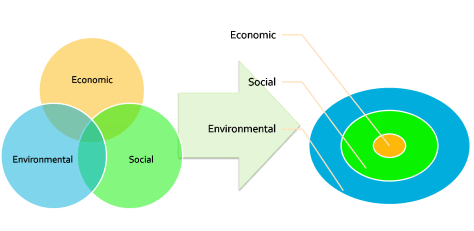
triangleAlmost everyone accepts some version of the “sustainability triangle” which includes 3 “E’s”…

  1. Environment
  2. Economy
  3. Equity (as in social equity or justice)

While the words used by different communities of scholars or practitioners may differ, we often see symbolic representations of these three basic concepts associated with the word sustainability. Sometimes these three concepts are depicted as overlapping circles.

threecircles

These common and generally accepted symbolic representations are useful, as they clearly require us to consider social equity or justice (often overlooked) as part of the sustainability equation.  However, they all have a common flaw…. they each assume competition among equally important perspectives.  This limited view allows us to negotiate tradeoffs between environmental quality and economic vitality, for example.

How often have we heard a business executive decry that “we just can’t afford to protect the environment today.”  Or perhaps a congressperson claim that some social justice legislation is a “job killer.”  As long as we accept these symbolic representations of sustainability, I suspect economic considerations will always win out over environmental or equity concerns.

But what if we took the same three symbolic circles and put them inside of each other, with the economy at the center? 

econsocenv02

We might then begin to understand that we can’t sustain a healthy economy within a sick society, nor a healthy society within a sick environment.  This symbolic representation of the same three concepts shifts the relationship they have to each other.  This is the representation of the three perspectives we need for the long term, which is what sustainability is supposed to be all about!

This picture changes everything!

We can not afford to have “either/or” conversations about money and society – nor about society and the environment.  We must begin to see that the economy is thoroughly embedded in society and the environment and change the assumption that it is okay to grow an economy by exploiting people and the natural world…..  this cannot be sustained.

Does this mean that the environment is more important than the economy?  NO!  It means that they are each critical to each other but there is a “directionality” to our sense of purpose.  In the study of living systems we learn to look to the “smaller” circles for function and the larger circles for purpose.  That is, human society can look to the economy as a tool to a serve a higher purpose, such as a healthy community and livable natural world.

This only makes sense if we see human nature as an integral part of “mother nature.”  Understanding that humans are apart of (rather than a part from) nature and subject to the “laws of Mother Nature” allows us to know who we are and where we fit in the world.  It gives us a foundation upon which to explore the big questions, like “who am I” and “why am I here?”  Students and teachers studying sustainability should be challenged by these questions in ways that are engaging and purposeful.

But how do we teach our classes based on this holistic, integrated nature of sustainability?  For me, the answer is by telling stories!  In my sustainability classes, I invite academics and practitioners to share stories about their lives and work in ways that integrate our desire for financial security, community connections, and a livable natural world.

A course on sustainability cannot afford to be merely objective.  There are values and purpose embedded in the study of sustainability…. yes, even within the academy.  There are even times when I’ve engaged in discussions of  spirituality in class!  Here is why...

We might see our individual self as a part of something bigger, lets call it the “family-self”, which is part of a”community-self” etc.  Continuing our exploration of the symbolism of circles within circles, lets now ask… “whats the next realm to consider?”

diineself

For some I suspect it might be the study of the ecology.

For others, perhaps cosmology.

For me, its the divine….

Sustainability studies, for me, is an opportunity to explore our relationship with some power greater than finite ourselves.  And what could possibly be more important than that?

—————————————————————

What is your conceptual foundation for teaching sustainability?  Please share your thoughts in the comments box below….

==============================================================================

I’d appreciate it if you would share this post with your friends and perhaps comment   For more ideas, videos and challenges along these lines, please check out my web page Just Food Now.

Want to help design a local food hub?

On December 1st, 2011, three local college students, Brian Downes, Jennifer Christian, and Tabbitha Greenough, gave a presentation at the community college downtown center in Greenfield, Massachusetts on ideas to enhance the local food system by developing more capacity to process vegetables.

The presentation was attended by about 50 local residents who came to see the results of a creative new class offered by Abrah Dresdale, on local food systems.  Part of their presentation focused on an idea to create a town food hub.  Their presentation is worth watching!

The very next day, an article about creating the Greenfield Food Hub in an abandoned factory building was published in the local paper.  The article was written by Kyle Bostrom, a Greenfield farmer and member of the town Agricultural Commission.

Coincidence?  Maybe…. or maybe an idea whose time has come.

Ideas like this evolve over time.  I first became aware of the concept when a regional newspaper, The Valley Advocate, published a story about a study conducted by yet more students (this time from the Conway School of Landscape Design) on how the nearby community of Northampton might create an infrastructure that was supportive of a local food system.

Recently, two Greenfield residents asked me to post a few questions to my local blog, Just Food Now in Western Massachusetts, to see who else might be working on a local food hub.  The response was encouraging.  Here are a few of the comments we received:

  • I have three friends that are part of food hubs in different parts of the country – in Hardwick VT, in the Bay Area, and in Southern CA.
  • I’m excited about the possibilities you are exploring to develop an important aspect of a more local food system.
  • There is Hardwick, VT, Intervale in Burlington, VT and there has been a group working to establish one in the Bellows Falls, VT area for the past few years and they have received a grant to do a feasibility study

And some words of caution:

  • We found a need to focus on the development of the social infrastructure first, (community gardens, surplus food and gleaning efforts, farm- to-school, cooking classes, neighborhood buying markets, etc.) and the network of organizations working on local food issues  – and build them until the need for physical infrastructure became clearer.
  • Who is the economics person to crunch the numbers on this project? It seems that if public money was used you would have to know how long until the project can pay itself back?

I was encouraged enough by the local response to bring this conversation to the global audience at World.edu.  Here are the questions we posed in the local blog (where you can find all of the previous comments).  The organizers of this project would greatly appreciate your thoughts (please put them in the comments box below).

1) Are you aware of other Food Hub examples in the U.S. or around the World?  Please share them here and let us know if there is anything that can be added or changed to make the Greenfield Food Hub most effective.

2)  Please share your knowledge relating to:

a. Laws, accreditations, compliances, etc. required to make a local hub reality

b. Infrastructure needs such as design firms, contractors, transportation businesses

c. Equipment needed to make parts of the Food Hub function and where to get it

d. Sources of funding

As you give feedback on each of these questions, please identify yourself and describe your expertise or interest in the Greenfield Food Hub.

Thanks for your help!

==============================================================================

I’d appreciate it if you would share this post with your friends and perhaps comment below.  For more ideas, videos and challenges along these lines, please check out my web page Just Food Now.

Occupy the food system: education and policy

I received quite a bit of feedback on my last post, Local Food: Lets Get Serious Now, which calls for a personal commitment to supporting the emerging local food system.  While most readers agreed that buying local was an important means of changing the food system, a few thought my unwillingness to “sleep outside in a public park” myself demonstrated a lack of commitment to the movement.

In my post, I applauded those young people (and old) who took to the streets in peaceful demonstrations, but I really don’t think all protesters need to “march.”  Eco-philosopher and social activist Joanna Macy reminds us that there are three dimensions to significant social change (which she calls “The Great Turning”).  They are:

  1. Actions to slow the damage to Earth and prevent harm to its beings (such as lobbying and protesting, blockading and conducting vigils, whistle-blowing and documenting problems).
  2. Analysis of root causes and the creation of alternative structures (such as education, policy and new organizations and businesses).
  3. Shift in Consciousness (perhaps the most powerful – and a topic for a future blog).

The Occupy protests have largely focused on action and public awareness.  And the December 4 Farmers March in New York City for example, helped focus attention on inequities in the global food system.  Unfortunately mainstream media did little to cover the story but this video does a nice job of presenting some of the major issues.

While some of us are out marching in the street and sleeping in public spaces, others need to be working on the “creation of alternative structures” to the current food system.  Small organic farms, community supported farms, backyard and community gardens, and all of the many organizations that work to re-localize the food system are critical to the continued emergence of alternatives to the corporately-owned industrial food system.

My hope is that the Occupy Movement energizes more people “vote with their food dollar” and buy local.  And while this sort of personal commitment is necessary, it is not sufficient to create lasting change in the global food system.  We need education and policy change too.  I hope the “occupiers” will continue to bring energy to the local food movement by joining one of the education or policy organizations currently working to support a more local and sustainable food and farming system.  There are many such organizations.

At the international level, la Via Campesina, is a significant voice for peasant agriculture and family farms.  I’m particularly attracted to their claim that peasant agriculture and small family farms can feed the world while reducing carbon pollution.  The banner above was from a protest march at the Climate Conference in Durban on December 5, at which time they called for all governments to “stop industrial farming that promotes pollution and climate change through high levels of use of petroleum based chemicals and to support agro-ecology.”

At the national level in the U.S., I’m attracted to the National Farmers Union (I belong to the New England chapter, which is a member-driven organization, committed to enhancing the quality of life for family farmers, fishermen, nurserymen and their customers through educational opportunities, cooperative endeavors and civic engagement).

The National Sustainable Agriculture Coalition is another policy group, with local and regional working groups throughout the nation.  The “SAWG’s” (regional Sustainable Agriculture Working Groups) have been particularly effective.  Many of us prefer to work close to home in local or regional groups, such as the Northeast’s Food and Farm Network which was created by the Northeast Sustainable Agriculture Working Group.

Each of us should find an organization we can support and join.  One that I helped to found is the local organization called CISA (Community Involved in Sustaining Agriculture) in the Pioneer Valley of Western Massachusetts.  If you don’t have one in your area – start one!

Perhaps we can take inspiration from the Victory Garden movement or the Women’s Land Army, which grew food for people at home during World War II.  There are many groups “pitching in” at the neighborhood, community, regional, national and international levels working to transform the food system.  If the authorities continue to take down the tents and move protesters out of the public parks, rail links and ports (military power always sides with economic wealth), I hope some of the occupiers will continue the struggle by joining with the education and policy organizations that have been working on these issues for years.

There is more than one way to “occupy the food system.” 

==============================================================================
I’d appreciate it if you would share this post with your friends and perhaps comment below.  For more ideas, videos and challenges along these lines, please check out my web page Just Food Now.

Systems Thinking for a More Sustaianble World

New Thought Evolutionary

Creating The Beloved Community - Together

Amadou It All

A Fascinating Fungal Fabric and a Humungous Human History

Levi Stockbridge Lessons and Legacy

What can we learn today from "Prof Stock"?

The Niche

Trusted stem cell blog & resources