Category Archives: Global Sustainability

Your life is a “story within a larger story”

When I introduce my Agricultural Systems Thinking class  to the concept of hierarchy, I often use our own lives as a metaphor for “subsystems within larger systems.”  In this blog, I will try to examine the relationship of subsystems within a natural systems hierarchy (or holarchy) to the “system above”, which provides the “system below” with meaning.  But first, lets  examine the title of the blog “your life is a story within stories.”  I borrowed this metaphor from a wonderful systems thinker, Michael Dowd, who wrote ”

“Each of us is a story within stories. My daughter’s life story is part of both my story and her mother’s story. The story of our family is likewise part of other stories larger than our own: the story of our town, our state, our nation, Western civilization, humanity, planet Earth, and the story of the Universe itself. Each of us is a story within stories within stories.

“There is a dynamic relationship between every story, the larger stories it is part of, and the smaller stories that are a part of it. Larger stories influence and add meaning to the stories that are nestled within them. For example, if my wife and I were to move across the country, my daughter’s story would be affected. Similarly, if my nation goes through a severe economic depression, experiences prolonged drought, or undergoes a major spiritual awakening, my community’s story, my story, and my daughter’s story will each be affected. The destiny of every story is affected by the larger stories of which it is a part.”

Get it?

As if the universe was trying to affirm this message, I opened a little book this morning which I had picked up at the library yesterday and read the first line in Hunger Mountain by David Hinton.  He wrote; “things are themselves only as they belong to something more than themselves: I to we, we to earth, earth to planet and stars…”

Hmmmmmm…..  sounds an awful lot like the image from my earlier blog.

I find meaning and purpose in my life by being useful to a system (story) larger than myself, in which my life is embedded.  This mental model of relationships helps me to know who I am and why I am here.  And it helps me choose how to invest my limited time on this planet.

Addictions are a coping mechanism

I sometimes wonder if the many addictions that humans seem to, …. well, become addicted to, result from a life focused on the little “myself” without a strong connection to the larger story.  And of course the addictions are many:

  • drugs (prescribed and illegal)
  • alcohol (at least its legal)
  • recreational sex (friends with benefits in today’s common lingo)
  • passive consumption of violent sports (football, hockey…..)
  • shopping (the number one addiction in America)

Of course, when not taken to the extreme these are normal human behaviors.  But we seem to be addicted to “the extreme.”  I wonder if these common addictions are coping mechanisms for a life lived without a sense of purpose, or a connection to that system (story) larger than the little “myself.”

I believe we find meaning and purpose in “larger” systems (in which our lives are embedded) because indeed, we are an intimate part of those larger natural systems.  This is not necessarily true however, for a human-constructed hierarchy.

We may not want to invest our lives in the next higher system in a human constructed hierarchy.  We may simply choose to “do our job” and take our paycheck home.  Many people today, seem to be willing to settle for this sort of life.  This seems a little sad to me.  I”m reminded of a Robert Frost poem, Two Tramps at Mud Time, where he writes;

My object in living is to unite
My avocation and my vocation.

I wonder how many of us are blessed with a vocation (that which we need to do) that is also an avocation (that which we love).

Frost continues:

Only where love and need are one,
And the work is play for mortal stakes,
Is the deed ever really done
For heaven and the future’s sakes.

When we live within a human-constructed hierarchy, we may not be in a position to work for “heaven and the future’s sake.”  Whereas, in a natural systems hierarchy, each subsystem is an intimate part of the next “larger” system.  We have no choice but to play for mortal stakes!  Indeed, we (the organism in the graphic below) contribute to the health (or ill health) of the human population, the larger ecosystem, the planet……
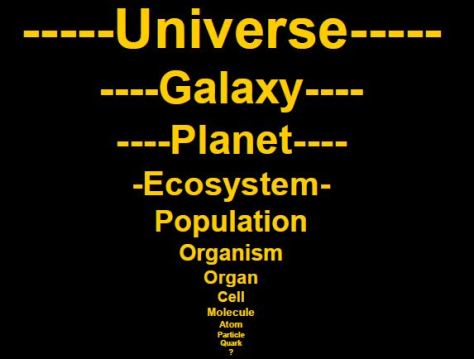
When I see myself as part of a human constructed hierarchy, I am likely to be competitive and selfish.  When I see myself as part of a natural systems hierarchy, a living system, it is in my best “self” interest to work for the good of the next larger system!

We are stores within stories

There is a visual tool that might help us picture the relationship among levels of complexity within a natural hierarchy called the Mandelbrot Set.  This is a mathematical set of points with a unique and distinctive shape.  As you look more closely at the shape however, you see the same shape repeated over and over again, seemingly infinitely.

A system in nature consists of smaller systems, upon which it depends.  Likewise the smaller systems are completely dependent on the larger system.  That is, we are stories within stories or using the Mandelbrot metaphor, common shapes within shapes.

But my family or community is a mess!

If we are not blessed with a healthy family and community (and I believe that those of us that are blessed with a healthy family or community have a special responsibiltiy to contribute to the well-being of others), still…. we ALL have a common, and powerful story.  It is The Great Story, and it is the greatest story ever told!

When we see ourselves serving a human constructed hierarchy of power and control, we may become scared and selfish.  And then the addiction that seems to dominate the national dialogue in America emerges, anger.

On the other hand, when we see ourselves as part of The Great Story of the continued evolution of the universe, we may choose to be of service to family, community, the planet, the universe, or even the divine.  When we see ourselves as something MUCH larger than the little “myself” – we may recognize our larger purpose and our obligations to other beings (both human and otherwise).

I believe we have a choice……

==========================================================

I’d appreciate it if you would share this post with your friends.  And for more ideas, videos and challenges along these lines, please join my Facebook Group; Just Food Now.   And go here for more of my World.edu posts.  Finally, for more systems thinking posts, try this link.
On Leadership….

Many organizations are over-managed and under-led. Daily routines are handled, but no one questions whether the routine should be done at all. Over time, the organization may find itself humming along efficiently, but not terribly effectively.  Outsiders begin to question the need for the organization – and a crisis in leadership ensues.  At this time of rapid social and economic change, leadership will help determine which organizations prove sustainable.   This post shares a few thoughts on effective leadership.

Dr. Robert Terry, former Director of the Reflective Leadership Program at the Hubert H. Humphrey Institute for Public Affairs of the University of Minnesota, presented six common views of leadership (and then adds a seventh) in his classic book, Authentic Leadership: Courage in Action.  The six common views of leadership are are follows;

  1. The first is called the trait theory. There are “born leaders” – like John Kennedy, Abraham Lincoln, Thomas Jefferson, and perhaps Barack Obama.
  2. The second type of leadership is called situational. Leaders respond to the situation – the war years “created” George Washington, Winston Churchill, and FDR. The “times create the man or woman.”
  3. The next leadership theory is called organizational. In this view, leadership is a function of position or rank in a hierarchical structure. This type of leadership is functional in many corporations, universities and of course the military.
  4. The forth view is the power theory, which suggests that position in a hierarchy isn’t as important as the ability to stimulate action. We all know people who passively occupy positions of authority, while people without impressive titles make things happen.
  5. Terry’s fifth type is called visionary. Leadership understands the past, scans current trends and helps point people toward a meaningful future. The visionary leader always asks the question “where are we going?”
  6. The sixth view, the ethical assessment theory, is also visionary, but it is a vision that involves ethical reflection. This leader not only asks “where are we going?,” but also asks “why are we going there?”

Terry believes that each of these six views of leadership is important, but incomplete. He proposes a seventh view that is a combination of all the others, which he calls the theory of fulfillment. In Terry’s view, leadership is exercised when people organize to engage and fulfill the needs of the people in the institution, while serving the mission and working toward a shared vision.

Terry’s seventh view is that “leadership is a particular kind of social and ethical practice. It emerges when persons in community, grounded in hope, are grasped by unauthentic situations, and courageously act in concert with followers, to make those situations authentic.”

I’ll restate the seventh view with some explanations in parentheses; “…leadership is a particular kind of social ( we are people in communities) and ethical ( thinking and acting for the sake of others) practice ( leadership is doing). It emerges when persons in community ( together), grounded in hope ( things can get better), are grasped ( see and called forth) by unauthentic situations, ( something is wrong), and courageously ( it won’t always be popular) act in concert with followers ( together), to make those situations authentic ( right).

Leaders are visionaries, dreamers, idealists – with their feet firmly planted on the ground. Effective leaders nurture a shared vision within the organization. They do this by constantly acting on their vision.

I’ll conclude this essay with two examples of visionary leadership. On the day that A. Bartlett Giamatti assumed the presidency of Yale University (July 1, 1978), he sent the following memo to the Yale faculty:

******************************************************************************************

In order to repair what Milton called the ruin of our grand parents, I wish to announce that henceforth, as a matter of University policy, evil is abolished and paradise is restored.

I trust all of us will do whatever possible to achieve this policy objective.

********************************************************************************************

I’m sure “the abolition of evil and restoration of paradise” is indeed a worthy vision. The only problem is that it wasn’t shared. The Yale faculty were shocked and upset by their new President’s lack of decorum.

Leaders must recognize the “boundaries” of institutional vision. Warren Bennis wrote in his book, Leaders: “…vision should be projected in time and space beyond the boundaries of ordinary planning activities – but not be so far distant as to be beyond the ability of incumbents in the organization to realize.”  Bennis suggests that: “boundaries are set by the values of the people in the organization.”  Sometimes leaders don’t recognize the boundaries until they are crossed. Giamatti crossed the line his first day on the job.

The second example is a truly shared vision from a slave rebellion in 70 BC against the Roman Empire. When the Roman General Crassus told the outnumbered slaves if they turn over their leader, Spartacus, they would not be punished (remember the 1960 movie with Kirk Douglas), each of the former slaves stood up, stepped forward and shouted out to Crassus “I am Spartacus.”

Now that was a shared vision.

===========================================================

Please check out my Just Food Now Resource Page and see our Sustainable Food and Farming page. Please share this blog with anyone who might be interested in either the Bachelor of Sciences degree or our 15 credit Certificate Program at the University of Massachusetts.

Antibiotic Resistance at Factory Farms "Scares the Hell Out of" Scientists

The headline above caught my attention when it first appeared in 2009.  Johns Hopkins University Scientists declared that antibiotics should be banned from animal feed.  If we didn’t take action, they warned we are likely to see an explosion of human deaths from previously preventable bacterial diseases as antibiotics become less effective.  I was sure this news would result in a public uproar….. I was wrong.   So when the latest news reports on antibiotic resistance appeared outlining the potential crisis in human healthcare, I had to wonder – maybe this time?  Will there be a public outcry about the use of antibiotics in the animal industry now?  Well, not yet!  But here is what the scientists are saying about the declining effectiveness of antibiotics.

While we have known this is an emerging global problem for some time, recently the medical profession is talking about a “catastrophic threat –  as big a risk as terrorism.”  There seems to be two point-sources for antibiotic resistance; one is hospitals which need antibiotics to safely do even simple surgeries.  The other place antibiotic resistance is developing is CAFO’s (concentrated animal feeding operations) or “factory farms.”

A well-documented report on the use of antibiotics in factory farms states:

Animals live in close confinement, often standing or laying in their own waste, and are under constant stress that inhibits their immune systems and makes them more prone to infection.  When drug-resistant bacteria develop in industrial livestock facilities, they can reach the human population through food, the environment (i.e., water, soil, and air), or by direct human- animal contact.  

In response to this problem, the FDA asked the animal industry to voluntarily reduce the amount of antibiotics used in factory farms.  The Animal Drug User Fee Act (ADUFA) requires drug companies to report the amount of antibiotic drugs sold or distributed for use in food-producing animals (although the industry seems to be fighting back to keep this information out of public eyes).  So how did the animal industry respond to this reasonable request?    A recent report of the Pew Charitable Trusts (a reputable group) reported that antibiotic sales for meat and poultry are soaring!

If we have known about this problem for a long time, why is nothing being done?  Last November, several hundred thousand citizens, including many senators and congressmen, urged the FDA to take action. It is doubtful however than anything will change without a public outcry. Pew Health Initiatives asks you to take action! They write;

On April 16, 2013, Pew will be hosting the second annual Supermoms Against Superbugs Advocacy Day. Concerned moms, dads and other caregivers will come to the nation’s capital to lobby the U.S. Food and Drug Administration, Congress and the White House to rein in the overuse of antibiotics in meat and poultry production – a practice that breeds dangerous superbugs that can infect humans.  Learn how you can get involved

There is a safe way to raise animals for meat without antibiotics!  You can make a clear statement of support for changes in legislation by signing the petition here refusing to buy meat products produced in a factory farm.  Learn more about the safe raising of animals and find producers non-factory farmed meat at Eat Wild or at your local farmers market!

===========================================================

I’d appreciate it if you would share this post with your friends.  If you are interested in sustainable food and farming, please join my Facebook Group; Just Food Now.   And please check out more on my personal webpage.

U.S. Energy Policy: burn America first!

In the U.S. presidential debates, both candidates have proudly declared that they will expand exploration and exploitation of domestic oil, so-called “clean” coal and especially natural gas with no mention of the impact of burning more fossil fuel on the climate.  The desire to become energy independent is surely a laudable goal, but burning more domestic fossil fuel only makes sense as part of a long range plan for investment in renewable energy and increased conservation.  The problem is that’s not the plan.

Our energy policy is to “burn America first!” 

New technologies have allowed the energy industry to exploit reserves that were inaccessible only a few years ago.  Hydraulic fracturing (hydrofracking) reminds me of the 17th century Francis Bacon claim that “we must torture mother nature for her secrets.”  Bacon of course was talking about the need for rigorous experimentation at the beginning of the scientific and industrial revolution.  Today, science and industry continue to “torture Mother Earth” so that humans can avoid the discomfort of choosing to conserve rather than burn fossil fuels.

Former-President George W. Bush had the courage to charge the nation with being “addicted to oil” but not the willingness to create policies to deal with it.  The first step in any recovery program from addiction is to admit that we have a problem.  But it seems that neither politicians nor the general public are willing to face this truth – and like other addictions – this one will end badly.  The U.S. Environmental Protection Agency warns the result of continued burning of fossil fuels will be sea level rise, melting ice cap, and more violent and unpredictable weather patterns affecting the economy and livability of the planet.

If the government agency responsible for environmental quality reports that climate change will undermine the future of the economy and quality of life everywhere….. why don’t the candidates have a policy to address this problem?  Of course, they can’t or dare not if it should lose them votes.  Both have learned from the public response to President Carter’s famous 1977 “cardigan sweater speech” in which he told us that the United States was the “only major industrial country without a comprehensive long range energy policy.”  Thirty-five years later – this is still true!

Carter reminded us that the energy we can save through conservation is greater than the amount we import.  He challenged Americans in a speech from the Oval Office to “not be selfish or timid” but to “put up with inconveniences and make sacrifices” or face a “national catastrophe.”  The response of the press and many people was to ridicule “President Cardigan” for his symbolic action of turning down the heat in the White House and wearing a sweater.  And of course Carter was a one-term president.

We can’t expect any politician to take an unpopular position (that might inconvenience people) when they are continually running for election.  The structure of politics is such that those serving in congress can only afford to have a 2-year planning horizon, presidents – a 4-year, and senators – a 6-year planning horizon.  Even good, intelligent leaders like President Carter, could not afford to think about the 7th generation and remain in office.

Both President Obama and Governor Romney have spoken in favor of government policies to reduce carbon emissions in the past, but they realize that asking American’s to deal with the reality of climate change is unpopular and may cost them the election.  So they avoid the issue.  We can’t wait for our leaders to lead on climate change!

Leadership must come from you and me…

Politicians will only be able to address the difficult truth if people like you and me take personal actions to reduce our consumption of fossil fuels.  By taking individual actions, we can begin to shift the way we think!  We must “start a parade” and if it is a big enough parade, the politicians will jump right up front and carry our banner!

Personal change alone will not make a big enough difference  – BUT  – unless each one of us makes a commitment to changing our behavior, politicians will never find the political will to sponsor much needed policy initiatives.  We must begin by turning out the lights when we leave a room, hanging our clothes out to dry in the sun, riding a bike, and….. well you know.

==========================================================

I’d appreciate it if you would share this post with your friends.  And for more ideas, videos and challenges, please join my Facebook Group; Just Food Now.   Go here for more of my World.edu posts.  To get a college degree see: UMass Sustainable Food and Farming.

Don't wait for the federal government to fix the economy – relocalize your money now!

“What would it be like if we invested 50% of our assets within 50 miles of where we live?”  

Woody Tasch founder of Slow Money.

Even though the U.S. economy was rocked by market and banking scams, Wall Street has rebounded quite nicely from the economic crisis they helped to create with assistance from a federal government that continues to support a “big corporation” economic policy.  Want proof –  just follow the money!

  • According to Neil Barofsky, inspector general for the Troubled Asset Relief Program (TARP), the financial  assistance provided those corporations that were “too big to fail” exceeded $3 trillion
  • The U.S. federal government Small Business Jobs Acts created a fund to spur local bank lending to small businesses, investing about 10% of the amount provided to the big banks through TARP

But that’s not all.  According to Amy Cortese’s new book, Locavesting: the Revolution in Local Investing and How to Profit From It, government subsidies, tax breaks and grants to big corporations are estimated as:

$10 to $30 billion to “big agriculture” each year,
$17 billion to oil and gas companies per year, and
… tens of billions to state and local officials to attract corporations to build stores, factories and warehouses in their communities that compete with local, small businesses.

There are fundamental flaws in how the federal government deals with the financial system.  They continue to underwrite big investment banks that play roulette with our money.  They have bailed out financial institutions and corporations deemed “too big to fail” and then allowed them to get even bigger.  And they subsidize multinational corporations that continue to move jobs offshore.

Healthy small businesses and vibrant community banks are needed to restore economic vitality in the U.S. because they create jobs and circulate money locally.  Multinational corporations have failed to produce sustainable prosperity, because they are more interested in making money than making things people need.

According to Sagar Sheth, cofounder of a successful technology firm, “we have lost a sense of respect for what brought us here – building things that the world can use.”  He continues…  “… you have these smart kids coming out of school and going to Wall Street and making a lot of money playing around with numbers.

Federal deregulation has made our financial system a casino for the rich – and they are playing with our money.  When Congress repealed of the Glass-Steagall Act, the relatively conservative culture of banking changed radically and became a free-for-all of risky speculation culminating in the collapse of 2008.   

A ballooning trade deficit producing a massive international debt, an underemployed middle class, the outsourcing of manufacturing jobs overseas, and the acceptance of speculative trading as the way to make “easy money” –  is not the road to a sustainable prosperity.  When 40% of the annual profit of large corporations are generated by the Financial Services Divisions that make speculative investments to maximize short term profit (rather than actually making something real) we are in serious trouble!

According to Cortese, the financial system supports “…a massive misallocation of capital away from its most productive uses and toward unproductive, even harmful, ones, such as speculative trading, subprime mortgagees, and the latest bubble du jour.”

Our trade, tax and bank policies create a business environment in which exploitative practices are the norm.  Given the financial power of Wall Street, efforts to regulate this dangerous behavior will be difficult.  Politicians that try are labeled “socialist” and marginalized.

What can the ordinary person do? 

Well…

Occupy Wall Street is one response!

Another is to keep your money close to home!

We need to relocalize our money!

Here are some ways how

Our corrupt financial system must be reformed, (even some bankers agree) but we can’t wait for the federal government to begin.  Politicians run for election full-time and depend on corporate money to stay in office. Wall Street has too much money and power to be reformed by government.

We must take action ourselves and reclaim the power to make the economy work for people, rather than allowing the 1% to manipulate the financial system to serve short-term greed.

Impossible you say?  I say – believe it!

Begin with small actions like those listed above.  Small actions taken by enough people will create a reinforcing feedback loop that can develop into a title wave of change.  If we start a parade, eventually politicians will want to jump up front and carry our flag.

Too many people just don’t believe it is possible to create real change…

To quote a classic……

“‘I can’t believe that!” said Alice.

“Can’t you?” the White Queen said in a pitying tone. “Try again: draw a long breath, and shut your eyes.”

Alice laughed. “There’s no use trying,” she said “one can’t believe impossible things.”

“I daresay you haven’t had much practice,’ said the Queen. ‘When I was your age, I always did it for half-an-hour a day. Why, sometimes I’ve believed as many as six impossible things before breakfast.”

Believe it

…. and then relocalize your money – today!

==========================================================================

For more ideas, videos and challenges along these lines, please join my Facebook Group; Just Food Now.   And for those of you from Amherst, please send me your favorite public initiatives to promote local food to add to my list for a future blog.  This post was inspired by the Pioneer Valley Relocalization Project.

Ethics, self-interest & a purposeful life

It seems to me that everyone from news reporters to the Occupy Protesters are questioning whether “normal business practices” are ethical.  Good question – there have been lots of wrongdoing exposed of late – but before we simply damn the business world as unethical lets look closely the nature of ethics.

This blog proposes a means of examining business practices within a larger and more comprehensive ethical framework.

Ethics change and grow over time.  Professor Aldo Leopold called for an expansion of rights to include environmental ethics in his classic essay, The Land Ethic (published in A Sand County Almanac in 1948).  Speaking of an earlier time, he wrote 

“when god-like Odysseus returned from the wars in Troy, he hanged all on one rope a dozen slave-girls of his household whom he suspected of misbehavior during his absence.”  

Now hanging slave girls would certainly not be considered ethical human behavior today (even on Wall Street), so I guess we’ve made some progress.  Homer’s Odyssey reminds us that concepts of right and wrong were not lacking in ancient Greece, but the rights of slaves had not yet been included in the ethical framework of the day. Over the past 3000 years, basic human rights have expanded from the family (Odysseus was very loyal to his family), to the immediate tribe or village, and in some places to all people of the nation.

In spite of this seeming progress, business ethics in the 21st century seem to be that “anything goes” as long as you don’t get caught breaking the law.  And then, if you have enough money or political power – even this is okay.   And of course, what seems immoral to some of us is just a standard business practice to others.  We live at a time in which extreme relativism has become a social norm. That is, what is right and wrong for you is different from what is right or wrong for me.  Taken to its logical conclusion, extreme relativism would contend that there is no evil other than that which I proclaim to be evil for myself.   In this context, as long as I am serving my self-interest I am acting ethically.

Nevertheless, many cultures across the human spectrum have shared ethical traditions.  C.S. Lewis gleaned eight principles from the Hebrew and Christian Bibles, the Koran, the Upanishads, the Tao Te Ching, and ancient Egyptian and Babylonian texts, that express the universal nature of what he called Natural Law.  I believe humans can (and must) agree upon an ethical framework or a perennial truth that holds true for all people.

But how can we think usefully about business ethics in a world in which self-interest dominates our sense of what is right and wrong?   Rather than damning business ethics as being inadequate, what if we looked at business ethics as part of a expanding circle of ethics founded on enlightened self-interest?   And further, what if we understood “the self” as much bigger and richer than merely the “economic self?”

The business world and quite often government officials refer to humans as “consumers” (as if buying stuff was our primary purpose in life).  We know this isn’t true, yet many of us seem willing to accept this diminished view of what it means to be human as normal.

What if we saw the “economic self” as an important and legitimate subsystem embedded within a larger system of “community self,” which itself is embedded in a still larger system of “ecological-self”? And what if the “ecological-self” was yet another subsystem embedded in a larger system that we might call the “universal-self”? Finally if we push this theme beyond the mere material, we might even see the universal-self as part of a cosmological or divine-self.  Each level of “self” is important but when we work toward enlightened self-interest in this framework, we are no longer limited to serving the economic-self alone.

By acting from our higher self (the family, community, the earth or the divine-self) we may discover of sense of meaning and purpose much richer than mere financial success (which beyond some minimum level doesn’t make us happy).  Without this broader perspective of self however, we are left to find meaning in common distractions like drugs, alcohol, recreational sex, video games, passive consumption of violent sporting events, and of course our number one distraction – recreational shopping.

I believe that many ills in society result from a diminished understanding of who we are as humans.  As long as we believe we are primarily economic beings, we will never be happy – because we can never have enough.   We we become the people of “more” – more money, more stuff, more college degrees, more shoes, more promotions at work, more gadgets, …. more.

And in this quest for more, we are hitting a “bottom” as a society that is much like the bottom of an alcoholic or drug addict, or someone who has maxed out their credit cards.  While this is a painful experience for individuals and society alike, it is in fact good news because the bottom is where recovery may begin.

I was on a panel a few years ago with Jordan Belfort, the self-proclaimed “Wolf of Wall Street” who told his story of riches, extravagant lifestyle, and eventually jail.  Mr. Belfort seemed to have redemption from the disease of more and told a group of entrepreneurs at UMass that “crime doesn’t pay.”   But the story of depravity, suffering and redemption is not only the story of unethical stockbrokers. The line between good and evil passes through every human heart.  We are all capable of unethical behavior. But we all also have the opportunity to experience redemption by serving a higher sense of self, and we may begin whenever we choose.

I believe we can find our way to redemption as a society through service to community, the earth or perhaps the divine – or we can find our way to redemption through pain and humiliation (for individuals this means jail – and for a society it may mean economic collapse).  I believe we have a choice.  If I see myself as merely an economic being serving a narrow self-interest, then fear of punishment may be an effective incentive for ethical behavior. But when I see myself as an economic, communal, ecological, universal and cosmological being, the result is not only “right” behavior, but a joyful and purposeful life.

==============================================================================

I’d appreciate it if you would share this post with your friends.  And for more ideas, videos and challenges along these lines, please join my Facebook Group; Just Food Now.   And go here for more of my World.edu posts.

What will you do when the lights go out (again)?

An unusually early snowstorm in the Northeastern U.S. left three million people without electricity for up to ten days at the end of October.  While some deaths were reported (mostly caused by carbon monoxide poisoning from using gas stoves, generators, and even charcoal grills indoors), for most of us it proved to be a week of inconvenience and discomfort.

The local newspapers covered the storm extensively, sharing stories about long lines at the fast food restaurants, people hanging out at coffee shops to get internet and stay warm, and many showing up at the library or other public buildings to charge their cell phones.  Letters to the editor criticized the electric companies for ill-preparedness and politicians promised to investigate the situation!  Lots of people seemed pretty angry about the disruption in electrical power (something that is relatively common in much of the world).

A story nobody covered however happened in my basement, where neighbors gathered each evening for dinner cooked on the wood stove.   As someone who teaches classes on sustainability, I figure I need to be somewhat prepared for “the end of civilization.” 

Okay, so this is bit of an overstatement (I hope), but I do think everything we consider normal (plentiful food in the stores, lights that turn on at the flick of a switch, and ready supplies of fuel – just to name a few) will come to an end someday.   Why you ask?  Well, lets consider;

  1. Peak oil – If something can run out….. it will run out.  Easily accessible fossil fuel is an energy resource of the past.  And we are not doing much to develop alternatives, are we?   Well, are we?
  2. Global climate change – I don’t know about you – but it hardly seems “normal” when my home state of Massachusetts experiences a hurricane, a tornado, tremors from an earthquake, and a major October snow storm in the same year.  Something is up…..
  3. Economic stress – I guess you read the newspapers too.

So, yes….. I think we are experiencing a “new normal” in which power outages, fuel shortages and periods in which some foods won’t be available will be more commonplace.  I don’t know when……..   but if the lights can go out…. well, they will go out.

And, yes….. I confess to have done a little work in preparation for time when the electricity might shut off for a few days.  Over the past few years, my wife and I (okay, mostly me… she thinks I’m a little nuts) have invested in:

  • A big garden
  • Solar hot water
  • A wood stove
  • An alcohol cook stove
  • A small generator
  • Oil lamps
  • Efficient hand-cranked flash lights
  • A water filter and rain barrel
  • A chain saw
  • A portable toilet
  • And chickens….. yes, we have fresh eggs when the stores are closed

I’m not a survivalist nut…. no, really.  But I think a little preparation might be good practice for the day when power outages are part of everyday living.

So, what happened when the lights went out at my house?

Well, we weren’t prepared for a snow storm in October.  One of the things you need to run a generator is gasoline.  When the lights went out, I went out to the garage, pulled out the generator and realized we didn’t have enough gasoline to get through the night.  Undaunted we went around the neighborhood and siphoned gasoline (with permission) from lawnmowers that wouldn’t be used until next summer.  We had lights!

The generator provided just enough electricity to keep the freezer (with 25 frozen chickens we had raised in our backyard last summer) humming along.  The refrigerator was next and then a few lamps to read by.  We spent a quiet evening by the wood stove sipping tea we warmed on our alcohol stove.  And we woke to a world in which tree limbs were everywhere and power lines lay on the ground.  It didn’t look good.

The first neighbor who showed up had heard the generator and asked to put a few things in our freezer.  The next neighbor wanted to take a shower (the sun was shining and the solar system was making hot water).  And then folks began stopping by  just to get warm and charge their cell phones.

For most people, the week in the dark began as a bit of an adventure and turned into a depressing and cold week….. well, everywhere except in our basement.  There we had food (salvaged from thawing freezers in the neighborhood), hot coffee and tea, and good conversation.  My wife served breakfast each morning of local (from our backyard) eggs.  A few family members and neighbors spent the night.  I got some help removing tree limbs from the yard.  We even provided internet service (I have no idea why it was working).  My wife and I enjoyed being able to help a few friends simply be a bit more comfortable.

And then the lights came back on!

So, what did we learn?

Well, perhaps a few more of us might want to be prepared for the next time the lights go out.  That’s pretty obvious. You can start with any of the items on the list above.

But what about the deeper meaning?  For me, it was about neighborliness.  I believe we have a yearning for community.  Bill McKibbon, in his book, Deep Economy, wrote “if you are a poor person in China you have plenty of friends and family around all the time.”   But this is not true for the average suburban homeowner in the western world.  For the suburbanite he wrote, “….adding a new friend is a big deal.”  We lack human connections. Frankly, I really liked having friends and neighbors stopping in, unannounced.  Nobody has stopped by since the lights came back on.  I miss them.

What else?  I noticed how difficult it was for people to ask for help.  We need to work on this.  Hyper-individualism will literally kill us if we don’t learn to depend more on each other.  My thing is food.  I grow way too many vegetables.  In the summer, I like to put the extras out in front of the house  for anyone walking by to take.   I also enjoy helping people get started raising hens (for the eggs of course).  And we give away lots of eggs.

But this is only a beginning.  Maybe we should start practicing asking for help before the lights go out again.  And how about sharing a snowblower among a few families?  Do we all need a 40 foot extension ladder?   But sharing tools is the easy part – its difficult to borrow a ladder when you don’t know your neighbor’s first name.

Last fall I joined with a group of neighbors to read  Navigating the Coming Chaos: A Handbook for Inner Transition.”   Caroline Baker suggests that to be prepared for the pain and confusion of the coming crisis, we might want to try to become better practiced at dealing with despair.  She suggests a few tools such as mindfulness meditation, story telling, and “inflicting joy” on each other.   At least we might want to get to know our neighbors a little better.  When things get really bad, it won’t be enough to be able to siphon a little gas from your neighbor’s lawnmower.

As the impact of peak oil, climate change and economic stress accelerate, we may learn that growing food, finding clean water, and providing heat will be among the easier transitions.  More difficult perhaps may be learning to communicate effectively while we are hungry and cold, to barter and trade with our neighbors, and to support each other as all the things we take for granted today slowly disappear.

Thomas Malthus wrote in 1798 “the mighty law of self-preservation expels all the softer and more exalted emotions of the soul.”  He predicted chaos in response to what he called “…the chilling breath of want.”   I suspect he is right.  If we are to survive the coming chaos, we’ll need to prepare both our homes and gardens as well as our souls for a new and much harsher world.  But perhaps in the pain and despair, we’ll rediscover what it means to be a human being again, living in community.

 So what will you do when the lights go out (again)?

==============================================================================

I’d appreciate it if you would share this post with your friends.  And for more ideas, videos and challenges along these lines, please join my Facebook Group; Just Food Now.   And go here for more of my World.edu posts.

Just food now: taking personal responsibility

In my last blog, I presented some ideas on how local government, colleges and community groups might help to strengthen the local food economy.   In this blog, I will share some ideas on how individuals can contribute directly to the long-term health of local food systems by changing our behavior.

But wait you say…..  how can individuals make a difference when government, corporations and university research and education all support industrial agriculture?

Well, lets begin with the assumption that investments in a local food economy make sense in the long term as we face increasing stress to the industrial food economy.   Then if we look at the systemic structure of large systems like corporations and government, we see that their behavior is governed by powerful mental models that discourage their leaders from acting on a long-term perspective.   Let ask…. “who among our leaders has a planning horizon that allows them to think in the long term?”   Afterall…..

  • those we elect to the U.S. Senate want to get elected every 6 years,
  • the President of the United States wants to get elected (or be succeeded by their own party) every four years,
  • those we elect to the House of Representatives want to get elected every 2 years,
  • most local officials run for election every 2 or 4 years, and
  • corporate leaders must show increased profits every quarter (3 months) to be successful!

Given our expectation for immediate results, how can any of these leaders take actions that will pay off in the long term and expect to remain in leadership?   WE have to begin to change the mental models governing western culture by changing our own behavior FIRST!

As I suggested in my last blog, if WE START A “LOCAL FOODS PARADE” (based on new mental models), these leaders will jump right up front and carry our flag!

Leadership of the local foods movement is in our hands!

While we need to continue to work with local government, businesses, colleges and community groups, we also need to take action as individuals to directly support local food and begin to shift mental models.  Here are a few things we might do now:

  1. If you live in an apartment, plant a few vegetables or herbs in window boxes or on the patio. And of course walk or bike to one of our farm stands or farmers markets to buy local food whenever possible.  Better yet, join a CSA!
  2. If you live in a suburban neighborhood, tear up that lawn and just grow food now!  And then teach your neighbors how to grow more food.  Can and freeze as much as possible, and share it with your neighbors.
  3. If you are in less populated part of town and maybe have a large yard (like some owners of “McMansions”), grow a large garden with fruit trees.   And don’t forget  hens, chickens and rabbits for meat, perhaps a milking goat, and bees!
  4. If you live on a farm, grow more food crops (for people).  Much of the farmland in New England is used to produce hay (some for cows, but much for riding horses).  Is this the best use of farm land?
  5. If you are responsible for a public building, grow food on the rooftop.  This not only produces food but makes heating and cooling the building less expensive.   Or look to re-configure parking lots and other open areas with raised beds such as the urban organiponicos in Cuba.

And no matter where you live, think about ways we can make food farming a more attractive lifestyle. Farmers (especially those who don’t own land) struggle with the economics of a food system that keeps prices artificially low through public subsidies and failing to pay for externalities. If we want more local food, we need to help these farms compete more effectively within the global food system.

We all need to begin by imagining possibilities and then getting to work in our backyards, neighborhoods, local government and educational institutions.  There are plenty of examples of ways in which you can get involved in creating a sustainable food system.

Individual Actions

1. Join the Slow Food movement, which “unites the pleasure of food with responsibility, sustainability and harmony with nature.”

2. Buy Fair Trade food products which ensure that farmers receive a fair price for their labor.   And why not try out this cell phone app to determine which products are “healthy, ethical and green.

3. Support Bioregionalism which encourages us to get our food from an area defined loosely by natural boundaries and distinct cultural human communities.

4. Work for clear public commitment to a nutritious diet for all, fair wages and working conditions for farm labor, and a living wage for farm owners.  Share the idea of a local Food Commons with your neighbors.

5. And perhaps the most effective way to support local food is to begin to uncouple your diet from the global industrial food economy starting with avoiding all factory farmed animal products such as eggs, milk, meat, and cheese.   Try to increase the number of food products you buy from farmers you know!

What else?   What would you add to this list?

==========================================================================

For more ideas, videos and challenges along these lines, please join my Facebook Group; Just Food Now.   And for those of you who still wonder if one person can make a difference, please see an essay I wrote on this topic called “Saving the world – one clothespin at a time.”

Food Sovereignty: the people's response to the global food crisis

Last week’s blog, “The Future of Food; Dealing with Collapse,” elicited a lot of comments.   A few of them reminded me that if we are going to address the global food crisis, we must listen to the people who do most of the work growing food.   We must hear from the peasants, farm workers, and small landholders who grow 50% of the food on the planet.

Without their voice,  policy makers responding to the food crisis, will continue to invest in the same industrial model for growing food that is the root cause of the problem.

If we care about sustainable food and farming, we must work for Food Sovereignty.

According to La Via Campesina, “Food Sovereignty is the right of peoples to define their own food and agriculture.”   One of the “raps” against sustainable agriculture is that while we talk about Social Equity as one of the three principles of sustainability, most of our efforts focus on Environmental Integrity and Economic Vitality.  Food Sovereignty provides a framework to make sure we maintain a focus on justice!

Food Sovereignty is about solutions!

La Via Campesina is a global movement of peasant farmers and workers.  In 1996, they introduced the concept of Food Sovereignty at the World Food Summit in Rome, and since then the principle of Food Sovereignty has been adopted by many organizations.

This movement which brings together the environmental, economic and social aspects of food production was created to serve the needs of small and medium-size farmers, migrant workers, the landless, women farmers, and indigenous peoples from all over the world.  These are the same people who are most likely use agroecological principles to grow food in a way that builds rather than degenerates natural resources.

A recent United Nations study claims that small farmers, using agroecological techniques, can double food production in 10 years.   These techniques are supported by the International Peasants Movement, La Via Campesina, which claims that peasants can feed the world.

According to Via Campesina “food sovereignty prioritizes local food production and consumption.  It gives a country the right to protect its local producers from cheap imports and to control production. It ensures that the rights to use and manage lands, territories, water, seeds, livestock and biodiversity are in the hands of those who produce food and not of the corporate sector. Therefore the implementation of genuine agrarian reform is one of the top priorities of the farmer’s movement.”

This global movement however, is not only relevant in developing countries.  Last week, a town in Maine passed the first Food Sovereignty law in the U.S.  I encourage you to learn more about this movement and to support one of the 148 member organizations in 69 countries working for Food Sovereignty.  And join the millions of small farmers and workers around the world on April 17, 2011 to celebrate the struggle of peasants and rural people to survive and continue feeding the world.

To learn more, go to April 17, 2011 – International Day of Peasant’s Struggles.

==============================================================================
I’d appreciate it if you would share this post with your friends. And for more ideas, videos and challenges along these lines, please join my Facebook Group; Just Food Now. And go here for more of my World.edu posts.

Is the modern industrial food system "in collapse"?

Cassandra (of Greek mythology) the daughter of King Priam, foresaw the destruction of Troy by the invading Greeks (who of course had come to retrieve  Helen).  Cassandra warned her father of the impending disaster – but no one believed her!  It seems the God Apollo, who had given her the gift of prophecy, had also cursed her by preventing anyone from believing her.

Frustrating, huh?

I suspect Evan Fraser and Andrew Rimias might understand her frustration.  Who are they you ask?

Well, they are just two of the modern Cassandras, who are trying to help us wake up to the impending collapse of the modern industrial food system.  But it seems Apollo is still up to his old tricks….. because based on our behavior, it seems we are still ignoring the warnings.

We didn’t listen to Tristan Stuart who reminded us in Waste, that “infinite abundance is an illusion.”  Nor did we hear Carolyn Steel, who claimed in Hungry City “our food system is no more secure, ethical or sustainable than Rome’s was.”  And Julian Cribb’s new book about food, The Coming Famine: The Global Food Crisis and What We Can Do to Avoid It, is also likely to go unheeded.

Its all just too depressing, isn’t it.  The “foodies” seem to be too wrapped up in what Fraser and Rimas call “the New Gluttony,” which, in their words “turn food into fashion – and undermines the critical danger we face.” Of course, most people don’t think much about the food system and just take the current food system for granted.

If you are one of the majority of people who seem to believe that somehow the food in the grocery store will always be plentiful, will always be cheap, and somehow is actually good for you – you should read Empires of Food.   Most astute observers of the modern industrial food and farming system recognize that the industrial food system is harmful to people, society and the earth….  and is vulnerable to collapse.  Not convinced, well read what some of the experts are saying…..

Or listen to this 11-year old kid!

I suspect I’ll be accused of being “alarmist” by some readers who would prefer not to be disturbed.  But when there is danger in our path, an alarm is exactly what is needed.  A billion people hungry, another billion malnourished, and another billion ‘overfed’ sounds like a problem.   Students often ask how do we wake up those people living in denial.

Personally, I don’t spend a lot of time trying to convince people that a system built on cheap fossil fuel is at risk in a peak oil economy.  I won’t argue that continued erosion of the natural resources upon which our high level of productivity is based –  is a prelude to disaster.  Nor do I like to point out (especially to people who are just not interested) that a system that allows a few large corporations to control the food supply is fundamentally unjust.

I’m actually much more interested in working on solutions; like tax incentives for small, integrated local farms, public investment in bioregional food production and distribution systems, changes in zoning laws which support the “homegrown food revolution”, and public education programs encouraging family, neighborhood, and community self-sufficiency.

Relocalization may not replace the system of international trade which presently dominates the global food economy.  But there are surely things we should consider to help us build much-needed resilience into a food system in crisis today in the poorer nations – and on the verge of collapse in the industrialized world.

———————————————————————————————

Next week’s blog will explore some of these solutions.

==============================================================================
I’d appreciate it if you would share this post with your friends. And for more ideas, videos and challenges along these lines, please join my Facebook Group; Just Food Now.