
Lets “lose the A from the UUSA”….
As The Sierra Club outlined in an article titled “What’s in a Name?”… “Native Americans have long fought to change derogatory place-names,” and …. “it’s particularly offensive to Native Americans when geographical features in our ancient homelands and sacred places bear the names of violent colonizers.” Toward that end, in 2022, the U.S. Department of Interior changed the name of more than 650 geographic features across the country to remove a name offensive to Native peoples.
In an effort to understand the history of the name of our congregation, the Unitarian Universalist Society of Amherst, it might be useful to examine where this name came from in the context of a desire to disassociate our congregation from the name of a violent colonizer. Hence… this proposal.
The following is a proposal initiated by the UUSA Indigenous Awareness Circle and modified and subsequently approved by the UUSA Racial, Religious and Ethnic Justice Circle. It was submitted to the UUSA Board of Trustees in July 2024 for consideration.
Proposal: The Racial, Religious and Ethnic Justice Circle asks the UUSA Board of Trustees to form a helping circle to investigate and propose an appropriate means to disassociate the name of the congregation from the harms promulgated by Field Marshal Jeffery Amherst, a British Army officer and Commander-in-Chief of the Forces in the British Army.
============================================
Background and Context Information
This proposal was the result of several years of consideration by various groups within the UUSA, including:
● 2022-23 – UUA Common Read of An Indigenous People’s History of
the United States
● 2023-24 – UUA Common Read of On Repentance and Repair:
Making Amends in an Unapologetic World
● Indigenous People’s Day Sunday Services 2021 (short clip) by the Reverend Rachael Hayes (worth watching)
● Meetings of the Indigenous Awareness Circle of the UUSA
Assumptions:
● The Society’s name should reflect the core values of the
congregation, and…
● The Society’s name should project our commitment to being open
and inclusive of all peoples, and…
● The name of our Society currently centers and highlights an 18th
century militarist, white supremacist, and supporter of native
genocide.
Some related factoids on “can we really change the name?”
Well yes, we’ve changed it before. Specifically…
- The meetinghouse that was constructed in 1893 was dedicated as the First Universalist Parish of Amherst.
- The name was changed to Unity Church in 1898 as a unitarian congregation.
- In 1962, Unity Church voted to change its name to The Unitarian Society of Amherst.
- It is not clear when the name was changed again to the Unitarian Universalist Society of Amherst.
We have had four names in 130+ years.
Why is it important to change the name?
The name of an organization should reflect and represent the core values of the membership and be welcoming and inclusive to all potential future members. The current name fails to represent the commitment of the congregation to the Eighth Principle, which was approved by a vote of the membership, as it raises up the name of an 18th century war hero and white supremacist.
Have any other official bodies changed their name to recognize the transition from colonialism to independence?
It was done in India! Yes, Bombay is now Mumbai. Calcutta is Kolkata.
Madras is Channi…… and why? According to this story “India is merely sweeping clean the last corners of colonialism – offending few beyond upper-class English-speaking Indians and outsiders who have wrapped India’s identity in its anglicized names.”
There are 65 countries that have gained their independence from the United Kingdom and many of them changed names of towns, cities, states etc. when they gained independence from empire.
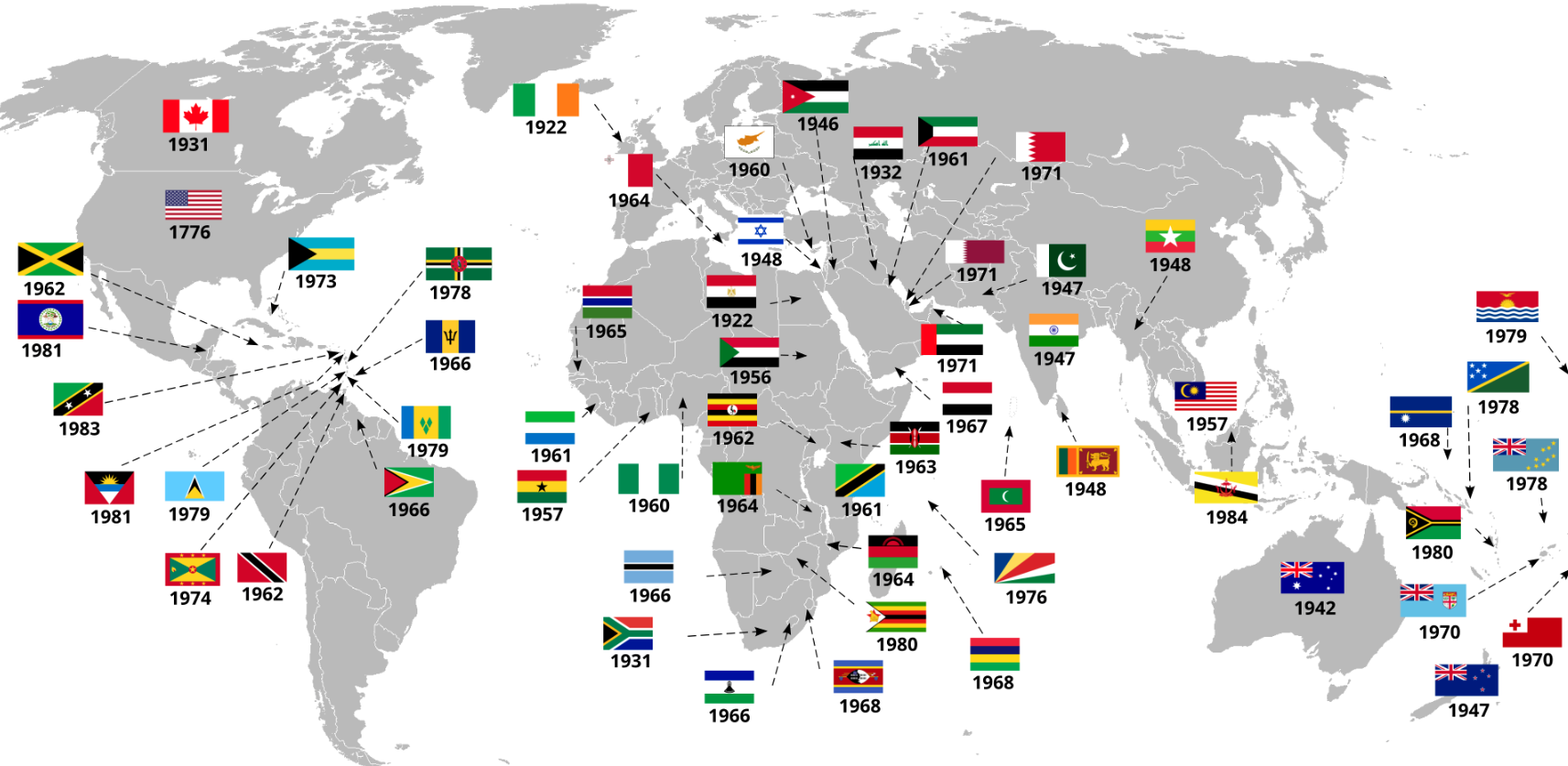
What about changing the name of the town? Wouldn’t that make more sense?
Perhaps, but this proposal is about changing the name of one of the institutions in town that has made a commitment to “dismantling racism and other oppressions in ourselves and our institutions.”
Still, a name change for our town has some local support!
From a local columnist. For years I’ve quietly favored changing our town’s name. Recently I encountered and signed a petition (sign here) titled “Rename the town of Amherst Massachusetts” started by Brendan MacWade and addressed to outgoing Gov. Charlie Baker and Amherst Town Council President Lynn Griesemer.
From a UMass student. The supremacist ideals that Lord Amherst embodied are more commonly associated with slavery, Jim Crow and the Ku Klux Klan, but northerners must accept that white supremacy isn’t exclusive to the South and hasn’t only targeted African Americans. Every day that I live in Amherst, I am complicit in subconsciously revering a potential war-criminal who condoned treating Native Americans like animals.
An Amherst resident. “This person (Jeffrey Amherst) whose name blemishes our community has such an odious reputation that the college named after him has replaced its sports teams’ reference to him in favor of one to an extinct distant relative of the African and Indian elephants”, (referring to Amherst College’s mascot switch from the Lord Jeffs to the Mammoths). “How should we proceed to rid ourselves of the centuries-old colonial imposition?”
From me. In 1757, John Nash, Isaac Ward, and Nehimieh Dickinson, three of the leading citizens of “East Hadley”, petitioned Governor Thomas Pownall Esquire, Commander-in-Chief of His Majesty’s Provinces in Massachusetts, to create a new precinct, independent of Hadley, which they recommended be named Amherst. In their letter, the petitioners extolled the virtues of Major General Jeffrey Amherst, who was being hailed as a hero in England’s war with France and had not yet been associated with the heinous recommendation to use germ warfare against the indigenous peoples of New England.
Are there other places named to celebrate Lord Amherst?
Lots! He was quite the hero in the 18th century! For example: Amherst Island, Ontario, Amherstburg, Ontario (location of General Amherst High School), Amherst, New Hampshire, Amherst, Nova Scotia, Amherst, New York, and Amherst County, Virginia.[63]
Has anyone else stopped “celebrating“ Lord Amherst in their name?
Well…. yes. Here are two examples:
- Goodbye Lord Amherst, hello Ancestral Drive
- “Goodbye, Mr. Amherst’: Why a decorated British general was stripped of his Montreal street”
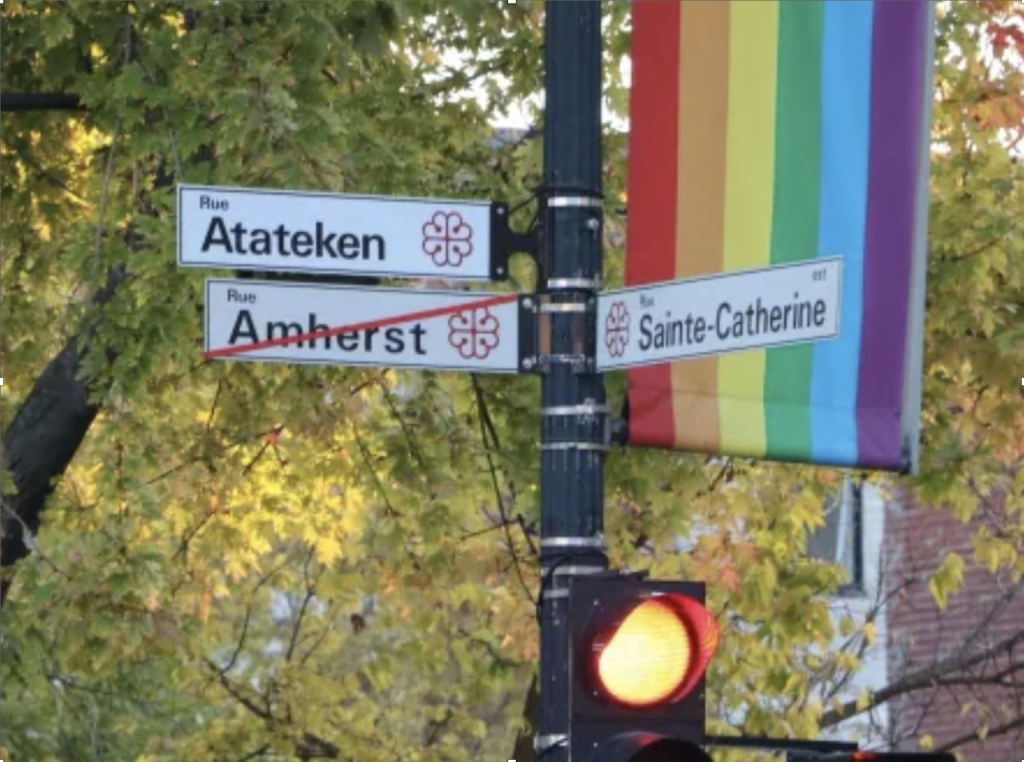
In 2009, Montreal City Councilor Nicolas Montmorency officially asked that Rue Amherst be renamed: “it is totally unacceptable that a man who made comments supporting the extermination of Native Americans to be honored in this way”. On 21 June 2019, the street was officially renamed Rue Atateken…. atateken being a Kanien’kehá word describing “those with whom one shares values.” Similarly, Rue Amherst in Gatineau was renamed Rue Wìgwàs (an Anishinaabemowin word for white birch) in 2023. In 2016, Amherst College dropped its “Lord Jeffery” mascot at the instigation of students. It also renamed the Lord Jeffery Inn, a campus hotel, to the Inn on Boltwood in early 2019.
According to Wikipedia…. Lord Amherst’s desire to exterminate the indigenous people is now viewed as a dark stain on his legacy and various agencies, municipalities and institutions have reconsidered the use of the name “Amherst”. A 2007 article in The Beaver, includes Amherst in a list of people in the history of Canada who are considered contemptible by the authors, because he “supported plans of distributing smallpox-infested blankets to First Nations people”.
In 2008, Mi’kmaq spiritual leader John Joe Sark called the name of Fort Amherst Park of Prince Edward Island a “terrible blotch on Canada”, and said: “To have a place named after General Amherst would be like having a city in Jerusalem named after Adolf Hitler…it’s disgusting.” Sark raised his concerns again in a 29 January 2016 letter to the Canadian government. mMi’kmaq historian Daniel N. Paul, who referred to Amherst as motivated by white supremacist beliefs, also supports a name change, saying: “in the future I don’t think there should ever be anything named after people who committed what can be described as crimes against humanity.”
In February 2016, a spokesperson for Parks Canada said it would review the matter after a proper complaint is filed; “Should there be a formal request from the public to change the name of the National Historic Site, Parks Canada would engage with the Historic Sites and Monuments Board of Canada for its recommendation.“ An online petition was launched by Sark to satisfy this formal request requirement on 20 February 2016 . On 16 February 2018, the site was renamed Skmaqn–Port-la-Joye–Fort Amherst, adding a Mi’kmaq word alongside the French and English titles.
Is that all?
Yes, for now. In the long run I suspect many others will follow. The question is “do we at the UUSA want to be a leader or a follower?” Here are a few “followers” who have rejected a proposed name change.
In 2019, the City of Ottawa decided not to change the name of a suburban street called Amherst Crescent “because no one officially requested it, and… there’s no proof that it was named after an 18th century British general who advocated for the genocide of Indigenous people.” In 2017, the Premier of Nova Scotia refused to change the name because “he has not heard concerns about the town of Amherst being named for the controversial historical figure.”
Have any other UU congregations changed their name?
Yes… we are researching that currently. For now, we know that In 2020, after years of consideration, two congregations previously named for Thomas Jefferson voted to rename themselves, the Unitarian Universalist Congregation of Charlottesville, Virginia, and All Peoples, A Unitarian Universalist Congregation in Louisville, Kentucky.
Have there been other name changes to try to address harms done to Native Americans?
Actually, the Department of Interior changed the names of 650 sites across the nation that had offensive names.
And the National Association of Tribal Historic Preservation Officers and the Wilderness Society have published a Guide for Changing Racist and Offensive Names. According to this guide:
- Place names have the capacity to tell important stories
- Because place names have such power, they have often been wielded by the place-namers to harmful ends, or to celebrate ugly ideas and events
- Left intact, these names can perpetuate racism, endorse hateful views and encourage a discredited or skewed telling of history.
- Across the United States are thousands of places and geographic features with names that honor Confederate leaders, perpetrators of atrocities against Indigenous people and historical figures with repugnant racial views
But really… why bother?
It is the beginning of the healing process. It is the beginning of the necessary work of repentance and repair for America’s original sin. There is much work to be done… this is the beginning.
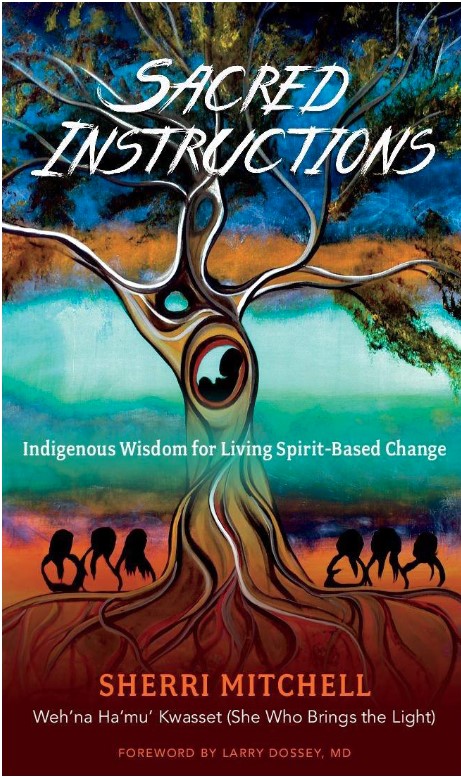
As Sherri Mitchell writes in Sacred Instructions….
“Our ancestors tell us that the Eastern Door is where we will gather to begin the healing of this land. It is here in the east where first contact was made between the Native peoples and the newcomers. It is here that the first blood was spilled between our people, and the long history of violence began. And, it is here on this same land that the healing must begin.
“We are told that when the people of the world rise up, a great healing will begin. In order for that healing to take root, the people must return to the place where the initial wounding took place and join together with one heart and one mind to heal the wounds that they carry within them, and those carried by Mother Earth.
“The United States was born in violence, and it has carried an imprint of that violence with it as it has grown. In order to transform this violent path, we have to go back to the seed that gave birth to this country and heal that imprint.”
If you are curious about how the name “Amherst” was chosen for our town, please see the document linked below. It is an interesting history.
 Changing the Story
3 thoughts on “Can we really change the name?”