
Sustainable agriculture and the public university

My last blog presented a vision of sustainable agriculture and called for a renewed commitment of the “body, heart and soul” of those of us working at public universities like the University of Massachusetts to agricultural research, teaching and outreach.  However if the public universities don’t re-energize their agricultural programs at a time when a billion people are hungry, another billion malnourished, and still another billion “overfed”, others surely will!

Agricultural education is traditionally associated with state universities, but many private colleges are adding courses on sustainable food and farming today.  I was asked recently by a reporter if there was much difference between these new programs and that of the public land grant university.  While I applaud the growth of the colleges into this field, I don’t believe they can provide quite the same “breadth and depth” of study as a major research university.  I must add however this will only remain true IF we invest in this important area of study and “put the public back into the public university.”

I’ve been thinking a lot about this lately as UMass is working to strengthen our agricultural programs by merging our Bachelor of Science programs in Sustainable Food and Farming and Managing Green Landscapes with the nearly 100 year old Stockbridge School of Agriculture.  This blog presents some of my own thinking on the role of the public university and the opportunity we have at UMass to create our own destiny.

Here is what I believe to be true…

  • My truth is that the industrial agricultural system currently practiced in most of the developed world is not sustainable, as it continues to leak toxins from their point of application, uses natural resources such as fossil fuel and water at rates greater than replacement, puts farmers and ranchers off the land, and results in a poorly nourished citizenry.  I believe that in New England, we can at least partially address these problems by investing in the continued development of more local farms and distribution networks.
  • My truth is that the commitment of the U.S. public university system to agricultural research and education has waned over the past 30 years, as discipline-bound science has come to dominate the research agenda.  Interdisciplinary research and application oriented studies that benefit small family farms, ranches and green businesses are not adequately supported through public or private funding.  Agricultural programs at the land grant (public) universities have suffered and are in danger of disappearing at a time when they are badly needed to address the triple threat of peak oil, global climate change and global pandemic from factory farms.
  • My truth tells me that the human quest for sustainability of the earth, including human and non-human communities, may be the best hope we have to revive those agricultural research, education and outreach programs of the public land grant university.  Maybe, just maybe, working in partnership with progressive farmers, consumers, and environmental and social activists to find a new way to farm, new ways to distribute food to those in need, and new ways to live, our public university agricultural research and education programs may experience a rebirth at a time they are most needed.

Its all about sustainability

The term sustainability is overused and abused by politicians, academics, agricultural commodity group leaders, and corporate public relations executives.  It has been co-opted by evangelists for the current industrial agricultural system, who continually try to narrow the definition to economic sustainability at the expense of environmental integrity and social equity.  There are times when I feel that we need a new word to describe the kind of agriculture that lasts.

But mostly I feel the debate, argument and even some of the hyperbole has been a good thing, for it focuses our attention on the lack of sustainability of the current industrial food and farming system.  So for me sustainability remains a big beautiful idea which acknowledges the importance of financial or economic vitality, but balances that goal with ecological integrity and social equity.

The quest for a more sustainable agriculture is a vision worthy of the full commitment of the “body, heart and soul” of those of us at the public university who teach, do research and work with people in communities.   It is a way for us to serve the public good while at the same time creating a sense of purpose in our lives.

Serving the public good

I believe that a clear understanding of how the land grant organization serves American citizens, those today and those yet to be born, is key to the future of the institution.  Most people agree that the system has an obligation to serve the public.  But we have difficulty talking about “who is the public ‑‑ and what is the public good?

Many of the current research, education and outreach programs are designed not to serve “the public” but to serve particular publics, or special interest groups.  I propose that there are interests, common to all people which we might call “basic human needs” such as:

  • affordable and nutritionally adequate food;
  • adequate clothing and shelter;
  • a healthy, livable environment free of violence;
  • opportunities to provide for one’s livelihood; and
  • accessible educational opportunities.

Our teaching, research and outreach should serve these larger public goods by working with the farmers, consumers and communities dedicated to building a more local food production and distribution system.  This is truly “public work.”

Working for the public university

Many of us came to work in agriculture at public universities because we cared about people, hunger, or the environment.  Over time however, we found ourselves working for the economic self-interests of those who held money and power.  Our current system of rewards and advancement pushes us in this direction.  If we are to save ourselves and the agricultural programs of the university, we must reestablish a commitment to public service.

There have been times in my own university career when I’ve traded off my civic ideals for personal advancement.  I too am a “sinner”.  Today I try to speak and live my truth, even when that truth is not very popular.

I know many faculty who have maintained a commitment to their ideals and have directed their work toward public priorities.  Many of these women and men affiliate with the sustainable agriculture research and education agenda.  If you are an agricultural researcher, teacher or extension worker, you are invited to join them.  This may be our last best chance.

In any case, I encourage you to speak out and tell your own truth  – whether you agree with mine or not.  As the Red Queen told Alice  “always speak the truth — think before you speak and write it down afterwards.

And perhaps you will “write it down” in the comments box below!

==========================================================================

For more ideas, videos and challenges along these lines, please join my Facebook Group; Just Food Now.
The future of sustainable food and farming at UMass

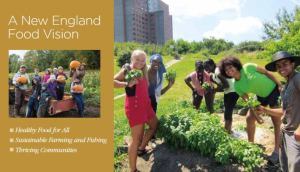
Our academic major in Sustainable Food and Farming in the Stockbridge School of Agriculture at UMass has grown exponentially over the past 10 years.  There is lots of interest in local farming and marketing in the region and lots of interest among young people in careers that supports this trend such as agricultural education, community development, advocacy and public policy.  Its been fun working with bright, passionate young people committed to changing the food system, literally from the ground up!

I’m asked from time to time if the growth in our sustainable agriculture educational program is  likely to continue!  I agree with Richard Heinberg when he states that if we are to create a truly sustainable food system in the U.S. we need 50 million farmers!  So, yes…. I think “the world needs Stockbridge”!

But predicting the future is a hazardous occupation and the truth is, we don’t know what the future will bring.  Nevertheless I think it is important to stick to our principles and try to offer the best scientific and experiential education possible, and let the future unfold in the lives of these bright young people.  So when asked about the future, I try to shift the conversation toward principles rather than predictions.  The principles upon which we have built our educational program are based on our vision of the future of sustainable food and farming in New England and include at least the following five components:

1.  First, a sustainable agriculture MUST address the multiple integrated objectives of economic vitality, environmental integrity, and social equity or justice.

This claim is understood by most governments, the United Nations, farm and advocacy groups, and universities.  Some corporations and agricultural commodity groups would like to present sustainable agriculture more narrowly (focused primarily on economic sustainability), but this self-serving position is in the minority today.  The sustainability movement grew out of the environmental movement of the 1970’s by adding social equity/justice to the conversation during the 1980’s – creating the so-called triple bottom line.

2. The long-term viability of large-scale, industrial agricultural systems is threatened by rising energy prices and global climate change in the long-term.

Industrial food production and distribution systems are financially efficient in the short-term and have resulted in low food prices.  However this system is highly dependent on chemical and energy subsidies and is vulnerable to collapse or at least gradual decay.  As energy costs go up and government begins to take climate change more seriously, global food prices will continue to rise and we will need to look at more energy-efficient alternatives to the global food system.

3. Although theoretically it is possible to imagine a large-scale industrial agricultural system that is more sustainable, we do not have the political will to develop the necessary government regulations and tax incentives to move corporate farms and major food distributors in this direction.

It would be possible to create a global, corporation-dominated sustainable agricultural system with the appropriate government-imposed constraints and incentives if we had the political willWe don’t – at least not at present.  The structure and purpose of the corporation itself won’t permit even the most progressive and courageous corporate leaders (and there are some) to voluntarily sacrifice profit to become more environmentally responsible and committed to social justice for very long.

Large-scale, corporate sustainable farming such as that proposed by Walmart will continue to maximize profit at the expense of the other two sustainability objectives, regardless of what their advertising campaigns might say.  Current experiments in sustainability by a few food giants are likely to be short lived, as the structure of the global corporation is designed to make money at all (sometimes legal and sometimes not) cost.  We must look to more local alternatives if we want long term environmental protection, equitable access to food and land, and a fair distribution of wealth.

4. A food and farming system with a local focus, managed by families and local community groups rather than corporations, is more likely to address all three of the sustainability objectives.

Addressing environmental and social justice priorities will be more likely when producers and consumers know each other and are part of a shared community.  As long as the negative impacts of doing business impact people “far away”, most of us will overlook these impacts in exchange for maximizing financial return.  However when farmers, distributors and consumers engage within a community, they will be more likely to include environmental and social impact into their decision-making.

Even the “father” of capitalism, Adam Smith, understood the need for a fair distribution of wealth.  His concept that the “invisible hand” of the free market (guided by competition, self-interest, and supply and demand) would result in efficient and fair distribution of resources was in fact based on two assumptions that are no longer true.

The first assumption was a shared sense of ethical behavior.  In the 18th century, there was a sense of “right and wrong” promulgated at least partially by the church.  Even when people and businesses cheated their customers, they were not proud of it (as it seems some CEO’s are today).  The second assumption that is no longer true is that most economic transactions took place between people who knew each other.   It was difficult to cheat a neighbor that you had to see every day.

The global marketplace has lost both a sense of “right and wrong” and any personal connection between producer and consumer.  Transactions are anonymous and the only “wrong” seems to be getting caught.  Under these conditions, the global market no longer generates a fair distribution of wealth.  We must localize the food system if we want it to be sustainable.

5. Local agriculture will be sustainable if and only if they are built on three ecological principles.

The principles are:

A.  Ecological “Rule” Number One – Use Current Solar Income

B. Ecological “Rule” Number Two – Waste Equals Food

C. Ecological “Rule” Number Three – Enhance Diversity

If local farms are modeled after large industrial farms, they too will be as non-sustainable as their larger cousins.  Unlike large monoculture farms however, small farms can be managed as ecological systems.  Progressive farmers are experimenting with new ways to integrate crops and livestock to use energy and nutrients more efficiently and agroecological research at the university must support this effort.

Although quite small, edible forest gardens which mimic late-stage ecological succession, are perhaps the best example of a sustainable food production system.  But even simpler intercropping or polyculture systems are more energy and nutrient efficient than large monocultures.  It is imperative for small, local farms to continue to transition to ecologically managed systems if they are to be competitive and sustainable in the long run.  Consumers can participate in this transition, by supporting these farms and working to make local agriculture thrive in their own community.

——————————————————————————————

The future of  agriculture in New England is local

If we are to stick to the principles espoused above, then the future of sustainable food and farming in New England is local!  I believe we will see a further strengthening of local markets (especially in the inner city) and the development of new integrated crop an livestock farming systems.  Some food items such as grain and dry beans, will be shipped by rail to feed livestock and people and hopefully will be sold through locally owned businesses.  But a recent analysis of local opportunities suggests that in New England, it is possible for us to produce most of our vegetables, half of our fruit, and also provide  for all of our dairy, beef, lamb and chicken needs for a population of about 15 million.  This could be done if we reduce our meat consumption, eat more fruits and vegetables, and increase the amount of farmland in production by about three-fold (similar to what it was in 1945).  For details, see the following report:

foodsolutions

The University of Massachusetts Stockbridge School of Agriculture will play an important role in this localization move toward a more sustainable New England.  Our undergraduate teaching program is already doing so as our graduates begin to make a difference on the landscape.  But we also must make a greater investment in agroecological research and more effective outreach working in partnership with progressive family farmers and non-profit community groups to realize the dream.

We have much work to do and as the Stockbridge emblem reminds us, this work will require the full commitment of our “body, heart and soul.

=======================================================================

I’d appreciate it if you would share this post with your friends.  And for more ideas, videos and challenges along these lines, please join my Facebook Group; Just Food Now.   And go here for more of my posts on sustainable and local farming.

PLEASE SHARE YOUR THOUGHTS IN THE COMMENTS BOX!